Where Real Estate Gets Its Dirt

What Is the MLS, Anyway? 

The Industry Relations Podcast is now available on your favorite podcast player!

Overview

Rob and Greg recap their time at the Signal conference before diving into one of the biggest debates facing organized real estate: what exactly is the MLS supposed to be? The conversation centers on “Pool,” ThousandWatt’s thought experiment for a national home exchange that would compensate listing contributors and charge data users. Rob argues the concept reveals a growing belief that the MLS is primarily a data repository, while Greg sees it as a modernized form of cooperation. From there, the discussion expands into the purpose of MLSs, the difference between cooperation and marketing, portal participation, private listing debates, government intervention, and whether the industry is losing sight of its core mission.

Key Takeaways

  • Rob discusses his new consulting engagement with Compass and why he believes independent opinions remain critical.
  • Highlights from the Signal conference, including the branding lessons behind Liquid Death and ThousandWatt’s “Pool” concept.
  • Rob reveals Pool closely mirrors the Nexus MLS model he previously attempted to build.
  • A debate over whether MLSs are fundamentally data repositories or broker cooperatives.
  • Greg and Rob clash over the relationship between cooperation, compensation, marketing, and listing distribution.
  • Discussion of off-market listings, seller choice, “velvet rope” marketing, and government involvement in real estate policy.
  • Why both hosts believe the industry needs a clearer answer to the question: “What is the MLS?”

Links

1000Watt’s Pool Website

Greg’s ‘Limited Exposure’ Article 

Rob’s Analysis of Connecticut Law 

Compass on Private Listings

Connect with Rob and Greg

Rob’s Website 

Greg’s Website 

Watch us on YouTube

Our Sponsors:

Cotality 

Notorious VIP

The Giant Steps Job Board 

Production and Editing Services by Sunbound Studios

ICE [Sponsor]

The world envies our MLS system. Let’s remember why.

In April, Lucie Fortier wrote a blog that, at the time, felt like a measured observation. Now it reads like a prescient warning.

Her argument was simple. The MLS is the engine room of American real estate. Portals, AI tools, and PropTech platforms run on MLS data. Agents, brokers, loan officers, appraisers and more operate within an ecosystem the MLS makes possible. Without comprehensive cooperation, none of it works.

Anyone following industry news this spring knows that argument was just put through the wringer.

Why the system is worth protecting

The American MLS system is rare. In most countries, real estate data is fragmented, unreliable or unavailable to the average consumer. What exists here is the result of decades of cooperation among professionals who understand that a shared system serves everyone better than a fragmented one.

That’s not a small thing. It’s the foundation that everything else is built on. And it doesn’t maintain itself.

What this moment is about

New tools and platforms are only as good as the data powering them. That data lives in the MLS — and the organizations investing in it are the ones that will matter on the other side of whatever comes next.

Lucie’s full piece is worth your time. Read it here.

Limited exposure, limited how?

Compass chief economist: The off-MLS marketing debate is ignoring 1.4M listings

I’ve known Mike Simonsen for a while, and catch his market update videos often. Here’s his argument in this Inman News piece: nearly 1.4 million homes were withdrawn from the MLS in 2025, which proves sellers already want limited exposure. So Compass didn’t invent off-market marketing. It built a structured version of what agents were quietly doing all along. He even gives it a stat, “days off market,” or DOFF. Love a good acronym and this one is great!

But, here’s the line I keep chewing on:

“What nobody is talking about is the 1.4 million listings that demonstrate how often sellers seek periods of limited exposure during the selling process.”

The word doing all the work is “exposure.” And it’s pulling double duty.

There’s exposure as time, how long a home is visible. And exposure as audience, how many buyers can see it. Withdrawals are a time move. Sellers pull the listing to reset days on market, repaint the kitchen, wait out the holidays, then relaunch. Mike’s own piece calls those windows “total invisibility.” That’s not limited exposure. That’s zero, on a timer.

Compass private listings are an audience move. The home stays for sale. Only a slice of buyers gets to see it.

So he’s collecting time-axis evidence and spending it on an audience-axis product. A withdrawal defers exposure. The seller still lands in front of everyone when it relists. A private listing forecloses it. Plenty of those buyers never see the place at all.

And if 1.4 million sellers really are begging for a pause, the clean fix isn’t a private network. It’s an MLS “coming soon” or hold status that stops the DOM clock while the listing stays wide open to every buyer. That’s a feature your MLS can ship. Funny how the data points there instead.

Sellers may want a pause button, not a velvet rope.

Katrina Romatowski: Rethinking Homeownership for the Next Generation with reSpace

The Listing Bits Podcast is now available on your favorite podcast player!

Overview

Greg Robertson sits down with Katrina Romatowski, founder and CEO of reSpace, to discuss a new approach to housing affordability through co-homeownership. Drawing on nearly three decades in real estate, development, and housing advocacy, Katrina explains how reSpace redesigns homes into private suites with shared common spaces and enables buyers to purchase fractional ownership interests. The conversation explores affordability, homeownership as a wealth-building tool, aging-in-place design, MLS challenges, and the growing need for alternative housing models. 

Key Takeaways

  • Katrina grew up throughout the Pacific Northwest, worked in construction from a young age, and built a career spanning real estate sales, development, and brokerage. 
  • Her real estate company was founded as a social purpose corporation, leading to the creation of a nonprofit focused on housing and mentorship for people exiting incarceration and recovery programs. 
  • The idea for reSpace emerged after selling a small infill home for nearly $1 million and questioning who could realistically afford it. 
  • Inspiration came from fractional ownership models such as Picasso, but Katrina wanted to apply the concept to primary housing rather than luxury vacation homes. 
  • reSpace creates homes with private suites that include ensuite bathrooms, closets, workspace areas, and personal amenities, paired with shared kitchens and living spaces. 
  • Buyers purchase an ownership interest in the property, allowing them to live in high-cost neighborhoods at a price point closer to renting an apartment. 
  • The model is designed to help first-time buyers, retirees, siblings, friends, and other groups gain access to ownership while maintaining independence. 
  • Katrina argues that homeownership remains one of the most important pathways to building middle-class wealth and that affordability challenges are increasingly shutting people out of that opportunity. 
  • A major hurdle for reSpace has been gaining MLS support for fractional ownership listings, despite existing standards that support partial-interest ownership categories. 
  • Current projects include The Grove in Seattle’s Ballard neighborhood and a historic mansion redevelopment in Leschi, with plans to expand through technology and partnerships. 

Links

reSpace

Snapshot by reSpace

Katrina Romatowski on LinkedIn

Links

Sponsors

Aligned Showings — MLS-owned showing software built to simplify scheduling, improve communication, and keep MLS data where it belongs.

Giant Steps Job Board – Built for organized real estate and PropTech, not generic tech bros and recruiters who don’t know what an MLS is.

Production and editing services by:

Sunbound Studios

Poking the Bear

A thought experiment about unintended consequences.

I don’t typically write longer posts but I recently heard someone on a recent podcast (only tangential related) describe a branding exercise that stuck with me. Imagine Nike opened a hotel. You can picture it instantly, can’t you? World-class gym. Sleek minimalist rooms. Maybe LeBron in the lobby. You’d book it tomorrow.

Now imagine Hyatt launched a running shoe. What would that look like?

Exactly. It would look like nothing. Some brands carry a gravity that extends naturally into adjacent spaces, and some don’t. The exercise isn’t about who’s better. It’s about which direction the brand energy flows.

I’ve been thinking about this a lot as I watch Compass, a handful of MLSs, and the broader industry slowly, maybe accidentally, push Zillow toward becoming something it has deliberately avoided for twenty years: a full-service brokerage.

The people doing the pushing should be very careful about what they’re wishing for.

The Corner

In January, Compass closed its acquisition of Anywhere Real Estate, becoming a conglomerate with 500,000+ affiliated agents across Compass, Coldwell Banker, Century 21, Sotheby’s, and ERA. In February, Compass and Redfin/Rocket announced an exclusive Coming Soon partnership, routing Compass listings to Redfin before they hit the MLS. In March, Zillow launched Preview as a response.

Then came the MRED situation. Nine Compass Private Exclusive listings triggered a feed suspension that removed 43,000 listings from Zillow overnight. Within hours, Compass launched a coordinated marketing blitz across its owned brands while competitors’ listings were invisible on Zillow. A federal judge ordered restoration in 48 hours. Zillow filed an antitrust complaint alleging a Compass regional VP sits on MRED’s board. The same board that pulled the trigger.

Private listings withheld from the MLS. An exclusive portal deal that bypasses the MLS. An MLS governance action that punishes Zillow while Compass capitalizes. A brokerage executive on the board that enforced it.

If you were in Zillow’s Seattle headquarters watching this, would you conclude the system is going to treat you fairly? Or would you start thinking about what your company looks like if it didn’t need any of them?

The Nike Hotel

Here’s the thing about Zillow becoming a full-service brokerage: you can picture it.

Two hundred million monthly visitors. A brand synonymous with real estate search. Zillow Home Loans already in place. A Premier Agent network that already connects buyers with agents, agents who could, with a different employment agreement, become Zillow agents.

You search on Zillow. You find a home. You click “Schedule a Tour” and a salaried Zillow agent shows you the property. You get pre-approved through Zillow Home Loans on the drive over. You make an offer through the app. The whole thing feels like booking a flight.

That’s the Nike Hotel.

Now imagine Compass launching a consumer portal to compete with Zillow. Five hundred thousand agents, sure, but what’s the consumer brand? What’s the reason a buyer in Tampa opens the Compass app instead of Zillow? That’s the Hyatt running shoe.

Zillow has resisted this model because Wall Street rewards asset-light platforms, not brokerages. But Redfin proved you can be both. And Redfin’s hybrid approach, salaried agents in key metros with partner agents handling the rest, showed you don’t have to employ everyone to control the transaction. If Zillow’s current model is being slowly strangled by private listings, feed disputes, and exclusive pre-market deals, the multiples question becomes academic. You can’t monetize traffic you can’t serve.

Meanwhile, at Compass

While Compass plays chess with Zillow, something is happening inside its own house.

Compass was built on exclusivity. Robert Reffkin recruited the industry’s top producers with a simple pitch: you are the best, and you deserve a platform that treats you that way. Reffkin’s personal cell phone number was part of the deal. It was the velvet rope.

Then they bought Anywhere. Now those same elite agents share a corporate parent with Century 21 and ERA. The holiday party got a lot more crowded. No top-producing Compass agent wants to make small talk with the Century 21 agent from the strip mall office, but here they are, under the same roof.  Ew.

And the technology edge? Compass positioned itself as a technology-enabled brokerage, and for a while that mattered. But everything they built before 2026 now feels like last season’s phone. AI has leveled the playing field so completely that every brokerage, every MLS, every single agent has access to tools that match or exceed what Compass spent hundreds of millions developing. The tech moat is gone.

So the cachet is diluted and the tech advantage has evaporated. I’m hearing that some of these high-end agents are looking at Side and other alternatives, trying to recapture the exclusivity that Compass used to represent. Compass bought scale and may be losing the thing that made the scale worth buying.

The Unintended Consequence

Rob and I talk a lot about 2nd and 3rd order consequences on our Industry Relations podcast. Here’s the scenario that should keep Compass up at night.

They’ve spent the last year building private listing infrastructure, cutting exclusive portal deals, and creating an environment where Zillow’s access to inventory is increasingly uncertain. They’ve poked the bear.

And the bear has $2 billion in cash, 200 million monthly visitors, a mortgage company, an AI platform, and a brand that every American consumer already trusts for real estate. If Zillow decides the only way to guarantee access to inventory is to control the inventory, they have every asset they need to do it. And unlike Compass, they start with the consumer, not the agent. That’s the high ground.

What would happen to Compass’ stock price when the Wall Street Journal reports, “Zillow Launches Mega-Brokerage”?  

The industry has spent years worrying about Zillow’s power as a portal. They should be much more worried about Zillow’s potential as a brokerage. A portal can be starved of data. A brokerage that controls its own listings can’t be.

Every feed suspension, every exclusive pre-market deal, every private listing that routes around the open market is a data point in a Zillow board presentation titled “Why We Need to Control Our Own Inventory.”

Can you picture what a Zillow brokerage looks like?

I can. And it looks like a Nike Hotel.



DAY 2

Cotality [Sponsor]

Floor plans—from scan to listing-ready in MINUTES

AI is opening up new possibilities in real estate—and at Cotality, it’s built directly into everyday workflows to improve listing quality, strengthen marketing, and give agents more time back.

Cotality’s new CorePlans™ is a great example. It lets agents automatically generate detailed floor plans, room dimensions, and descriptions directly from their iPhone Pro. 

Leveraging LiDAR technology and Cotality’s proprietary CoreAI, agents can create ANSI-compliant floor plans in minutes—eliminating the traditional 24–48 hour processing turnaround— with 99.96% accuracy. Fully integrated into Matrix™, everything uploads with one tap, with room dimensions and descriptions automatically added to the listing.

According to a 2025 WAV Group study, 85% of buyers find floor plans extremely valuable. They are the new essential marketing standard that buyers expect. 

There’s a clear gap between what buyers want and what most listings deliver. CorePlans help close that gap. 

Available first to MLSs with the new Matrix Listing Manager, then rolling out to additional providers that meet requirements. Want to learn more? For more information, reach out to your Cotality rep to schedule a demo or visit cotality.com.

Did MRED Blink?

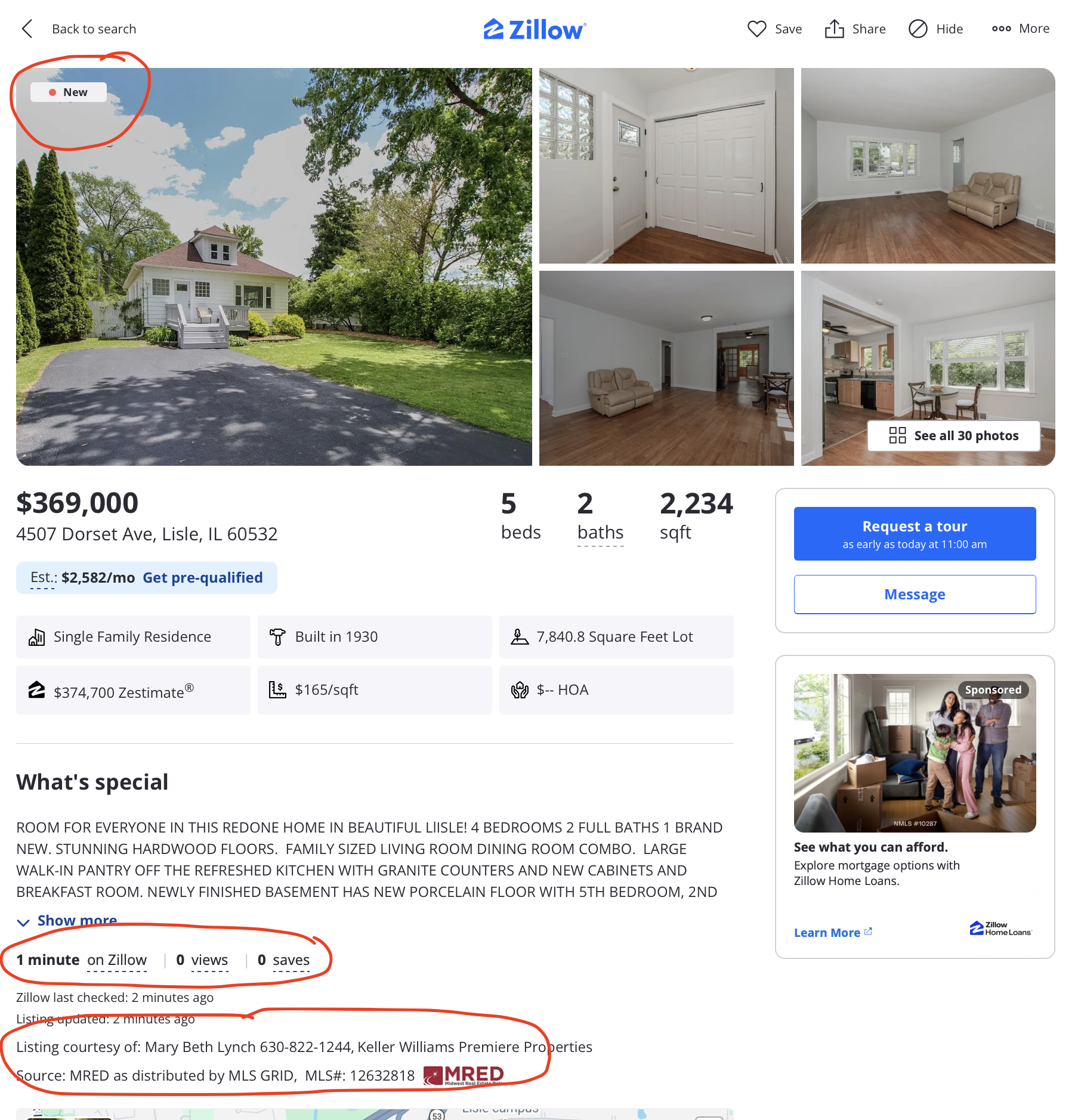
I’m not sure of the particulars of how the feeds work, and I know that some Chicagoland brokerages have already worked out sending listings directly in to Zillow. But this listing (from Keller Williams) this morning appears to be new, “1 minute on Zillow” and source is MRED. There are several others as well.

Did MRED back off on its threat to shut down Zillow’s IDX feed?

Anybody have the scoop?

Zillow sues MRED and Compass

Zillow sues MRED and Compass for conspiring to hide home listings from buyers and restrict competition

“In April 2026, MRED and Compass announced a formal partnership to expand MRED’s private listing network nationwide. It allowed Compass agents anywhere in the country to enter listings into MRED’s system — supposedly to “protect” those listings from pro-transparency platforms like Zillow. The explicit purpose was to extend MRED’s monopoly leverage far beyond the Chicago region and force competitors nationwide to abandon consumer protections. 

MRED made good on the deal almost immediately. By early May 2026, MRED demanded that Zillow reinstate Compass private listings in states hundreds of miles outside MRED’s territory — listings from agents who had already been warned they were violating Zillow’s consumer standards. 

The same day, the technology provider that distributes MRED’s listing feed threatened to terminate Zillow’s access entirely if it did not comply. MRED CEO Rebecca Jensen also serves as chair of that distributor’s board of managers, meaning the same person controlled both the threat and the mechanism for carrying it out.”

It’s a fight that had to happen. And it’s going to get really messy. In my estimation Compass has a lot more to lose than anyone else. Zillow has shown it can pivot. But Compass has gone all in on their 3-phased marketing strategy and that’s what’s at stake.

And at the end of the day, can anyone tell me what MRED is fighting for? What do the other members of MLS GRID think?

My main fear is that the biggest loser will be the organized real estate industry itself. Zillow in my estimation has the strongest voice to the consumer. And as the saying goes, “you don’t fight the man with the microphone.” If Zillow can successfully push the narrative that Compass is hiding listings from buyers and restricting competition, then the blow back will affect all of us.

Is anyone else afraid of checking their email nowadays? Can we all just pop a gummy and chill out for a while?

Introducing the MLS Channel Field Guide from Giant Steps

We Built the Field Guide We Wish We Had 20 Years Ago

If you’re a proptech company trying to sell into the MLS channel, you already know the basics: it’s complex, it’s slow, and nobody picks up the phone.

What you might not know is exactly how complex, how slow, and why nobody picks up the phone. That’s the part that takes years to figure out. We know, because we spent decades figuring it out ourselves.

Today we’re announcing something we’ve been working on for a while: The MLS Channel Field Guide.

I spend a lot of time speaking to new vendors and other vendors who may have been selling directly to brokers or agents who were curious about partnering with the MLS channel as a way for distributing their product. I’ve distilled all those conversations in to a presentation which I think does a great job of informing anyone new to the space. If you interested please go read the full blog post on the Giant Steps Advisors website and Let’s Talk.

Sponsored By Paragon Connect