Where Real Estate Gets Its Dirt

What is an MLS based on “First Principles”?

The Industry Relations Podcast is now available on your favorite podcast player!

Overview

Rob and Greg are joined by Michael Wurzer, President and CEO of FBS, for a live continuation of the IDX/data-distribution debate that started at the Columbus Realtors event and continued in a series of dueling LinkedIn posts. Rob argues the MLS should get out of data distribution and marketing entirely; Wurzer defends a reformed, usage-based IDX system; Greg plays referee. The conversation ranges from first-principles arguments about what the MLS is actually for, to pricing and licensing models, to whether a national MLS is closer than anyone thinks.

Key Takeaways

  • Wurzer proposes keeping IDX but shifting to volume/usage-based licensing instead of blowing up the current system
  • Rob argues the MLS’s only legitimate first-principle purpose is brokerage cooperation, not data distribution or marketing
  • Wurzer: licenses should follow use — display rights are separable from participation rights
  • Rob compares reforming IDX incrementally to “improving slavery” rather than abolishing it — Greg pushes back hard
  • Wurzer references Craig Cheatham’s writing on shifting licensing focus to how data is used, not who’s using it
  • Discussion of whether non-broker companies (House Canary, Zillow, OpenAI) should get separate syndication licenses distinct from broker/participant data licenses
  • Rob argues MLS “creates no data” — all data originates from brokers and agents (the “ultimate UGC”)
  • Wurzer counters that aggregation itself has independent value, distinct from the underlying listings
  • Debate over whether a national MLS is realistic — Rob claims only ~25 MLSs are needed to reach 85% listing share
  • Both agree clear cooperation as a nationwide mandate was likely a policy mistake
  • Wurzer references Daniel Jones (Hive) as working on a formal “MLS constitution” concept

Links

Riposte with Rob

Connect with Rob and Greg

Rob’s Website 

Greg’s Website 

Watch us on YouTube

Our Sponsors:

Cotality 

Notorious VIP

The Giant Steps Job Board 

Production and Editing Services by Sunbound Studios

Aggregation Aggravation?

The Industry Relations Podcast is now available on your favorite podcast player!

Overview

Rob and Greg open with Greg’s car breaking down in 112-degree heat outside Barstow, then dig into the FTC’s settlement with Zillow and Redfin over their leasing business deal, which regulators viewed as an attempt to dodge merger review. From there, the two spend most of the episode debating a bigger question raised by Rob’s recent exchange with Mike Wurzer: did the MLS create genuinely new value by aggregating listings, or was that value always meant for real estate professionals rather than consumers? The conversation ranges across aggregation theory, the history of IDX and portal dominance (Zillow, Redfin, realtor.com), whether companies like House Canary and paper brokerages even qualify as “brokerages,” and the 2008 DOJ settlement’s actual scope. It closes with a debate over how to legally define a broker at all.

Key Takeaways

  • The FTC pushed back on Zillow’s attempt to acquire Redfin’s leasing business without triggering merger review; the settlement requires Redfin to restart its own rental business, though it can still display Zillow rental listings.
  • Rob calls the $100M settlement a “slap on the wrist” rather than a real penalty for either company.
  • Rob’s central argument: the MLS’s aggregation of listings created value primarily for practitioners, comparable to Lexis Nexis and Westlaw’s value to lawyers, not inherent value for consumers.
  • Greg counters that aggregation itself creates new value regardless of who captures it, and that consumers clearly benefit from having listings in one place.
  • The two trace the history of real estate going online — IDX, the rise of Zillow, Redfin, and realtor.com — and agree the portals won because they outspent brokerages on user experience.
  • Rob argues the industry should unwind IDX in favor of straight data syndication to portals, separating “cooperation” (MLS’s original purpose) from “data distribution” (a later add-on).
  • Greg pushes back that most agents don’t actually get leads from portals directly, but Rob argues that undercuts the case for IDX mattering to them at all.
  • A long tangent debates whether entities like House Canary or paper brokerages qualify as “brokerages,” and whether the 2008 DOJ settlement (about brokerage business-model discrimination) supports keeping IDX — Rob says no, Greg disagrees.
  • The episode ends unresolved, with both agreeing to continue the debate and possibly bring Mike Wurzer on to discuss further.

Links

Debating Rob Hahn In Ohio: Are MLSs Killing Themselves?

Continuing the Debate with Mike Wurzer

Riposte with Rob

Connect with Rob and Greg

Rob’s Website 

Greg’s Website 

Watch us on YouTube

Our Sponsors:

Cotality 

Notorious VIP

The Giant Steps Job Board 

Production and Editing Services by Sunbound Studios

There and back again, the IDX debate continues.

The Industry Relations Podcast is now available on your favorite podcast player!

Overview

Rob and Greg dive into a major discussion about IDX, MLS rules, private listings, and whether MLSs should still control listing distribution in 2026. Using a Twitter exchange with Michael Wurzer as the jumping-off point, they unpack the history of VOWs, syndication, Zillow’s rise, and whether the industry is still operating on outdated internet-era assumptions.

Key Takeaways

  • Michael Wurzer’s IDX question leads into a larger conversation about MLS governance.
  • Greg argues MLSs could handle private listings with simple status changes.
  • Rob argues IDX was never intended to become the industry’s primary listing distribution system.
  • The history of ListHub, Realtor.com, Zillow, and syndication reshaping the industry is revisited.
  • Rob proposes MLSs focus only on cooperation while brokers control distribution themselves.
  • Greg pushes back on whether replacing IDX is actually simpler than adapting it.

Links

X Thread

Connect with Rob and Greg

Rob’s Website 

Greg’s Website 

Watch us on YouTube

Our Sponsors:

Cotality 

Notorious VIP

The Giant Steps Job Board 

Production and Editing Services by Sunbound Studios
Canary in a coal mine

HouseCanary Ignores Boundaries of IDX with Google Ad Integration

“This distinction matters here. As the industry has already debated with portal-to-AI integrations, a Google search results page is not the broker’s display. It is Google’s display. Sponsored ads amplify this problem because they are explicitly advertising, not informational browsing. When listings appear inside paid Google ads, they are being promoted, targeted, and monetized in a third-party environment that sits outside the IDX framework. IDX consent does not transfer to Google, nor to any advertiser using Google as the distribution channel.”

This isn’t really a HouseCanary story. Like most canaries in coal mines, it’s another warning sign.

I’ve started and restarted a post about the recent news of HouseCanary’s Google ad integration, but I don’t think I can add much beyond Victor’s response above. He lays out the issue clearly and directly.

This type of controversy isn’t new territory for HouseCanary. If this all feels familiar, it should. Remember their dust-up back in 2019?

I’ve spoken with a few MLS organizations that were contacted by HouseCanary about this new integration, and my understanding is that at least one MLS explicitly told them they did not approve of the implementation. That detail matters.

But as Victor points out, this is also another signal that IDX policy itself is aging poorly. As MLSs move toward a more decentralized, “every MLS for itself” rule-making environment, the inconsistencies and edge cases are only going to multiply. What’s allowed in one market may be off-limits in the next, and vendors will keep testing those seams.

Afordal, from RatePlug lets anyone get in to the all-in-one game

RatePlug launches Afordal, the first integration of home search, mortgage rates, pre-approval and special financing options.

RatePlug Launches Afordal: First Integration of Home Search, Mortgage Rates, Pre-approval and Special Financing Options

“Afordal solves one of the biggest pain points in residential real estate: aligning what homebuyers want with what they can afford,” said Brad Springer, Co-President of RatePlug.

He adds, “Afordal unites home search and financing to give buyers a clear path forward, allowing professionals to engage their customers more effectively.”

With Rocket buying Redfin and Mr. Cooper and Lower acquiring Movoto, the trend is clearly toward an “all-in-one” platform driven by mortgage. From what I gather, Afordal lets agents, brokers, and loan professionals create an IDX website based on affordability (see what they did there?). It also comes with a CRM, a Homebot-style drip nurturing campaign, and some social media campaign management.

Brad Springer has been in the industry for a while, and it’s great to see that he and his team are still innovating

Microsoft agrees to take down Bing Homes Portal

via GIPHY

Bada Bing

Microsoft Bing Real Estate Portal in Violation of Copyright Infringement – MLSs Must Act Immediately

“It seems like Zillow and Redfin started a relationship with Microsoft to leverage innovative OpenAI technology to deliver some interesting consumer benefits to people searching for homes on Zillow and Redfin. It is hard to ascertain how this relationship started with Bing Chat and evolved into Bing.com/realestate providing a full listing display breaking so many MLS rules, that links out to advertisers, and points to Zillow and Redfin as the sources of the data rather than the brokerage or MLS. It’s not Zillow or Redfin’s data to give!”

Victor Lund, WAV Group

Great write up from Victor regarding the Bing controversy, go read the whole thing. Sam DeBord was the first to start posting about this and Marian at Inman News did a story as well. Good reporting.

Okay so let’s first let’s get something straight right from the top, Bing.com/realestate is a mother fucking real estate portal, not a search results page.

  • I can like properties
  • I can save a property
  • I can setup a saved search
  • I can see multiple photos (sans watermark) – WTF?
  • I can “claim ownership”
  • I can see an “estimated value”
  • I can even get a mortgage!

And it appears that Zillow, Redfin and Realtor.com may be complicit in powering Bing. From Victor’s post,

“Here is how easily Zillow and Redfin can stop bing from accessing and republishing content – code courtesy of OpenAI “<meta name=”robots” content=”noindex”>.” Inventory is turning in 30-90 days in most markets, rendering search on Bing irrelevant in a short period of time. If current listings are not displayed to active home buyers in today’s tight market, consumers will abandon them. Of course, this would be a poison pill for Zillow and Redfin who rely on search engines for a significant amount of their consumer traffic.”

Victor Lund, WAV Group

Shout out to Homes.com for not being a part of this scheme, as Victor also points out.

But MLS organizations need to step up, more from Victor.

“MLS must protect the assets contributed by each broker, or firms will simply contribute their content to OpenAI for free, and access the listing content of other brokerage firms using OpenAI. CMA vendors like Inside Real Estate, Delta Media and dozens of others can stop paying $5 Million a year in Data License fees and access the data from OpenAI. An OpenAi driven CMA would work like Cloud CMAs revolutionary 1 Minute CMA, only it would be almost instant. Moreover, consumers could simply run their own CMA without a professional.”

Victor Lund, WAV Group

“AI” is the new “lion over the hill”. If MLS orgs want to protect their data licensing revenue you need to nip this in the bud now.

Can you modify/add compensation info to an IDX feed, on your own listings?

NEW REW BUYER-COMMISSION WEBSITE FEATURE LIKELY A GAME CHANGER

“We already have a feature that allows them to enhance their listings, add other photos, and do other stuff. So really, I thought to make an extension of that would be pretty easy and add another field that allows them for their own listings only to display the compensation.”

Morgan Carey in an interview with Michael Catarevas of RISMedia

Is this kosher under the new settlement rules? From my understanding if you are receiving a feed from the MLS you can’t have compensation information, even on your own listings. Although, I think this would be hard to enforce.

I believe if you manually entered a listing and added your own compensation that would be cool. But the fact you are receiving a feed from the MLS limits you. Maybe a VOW/BBO feed would be okay? Love to hear from anyone who has a good take on this.

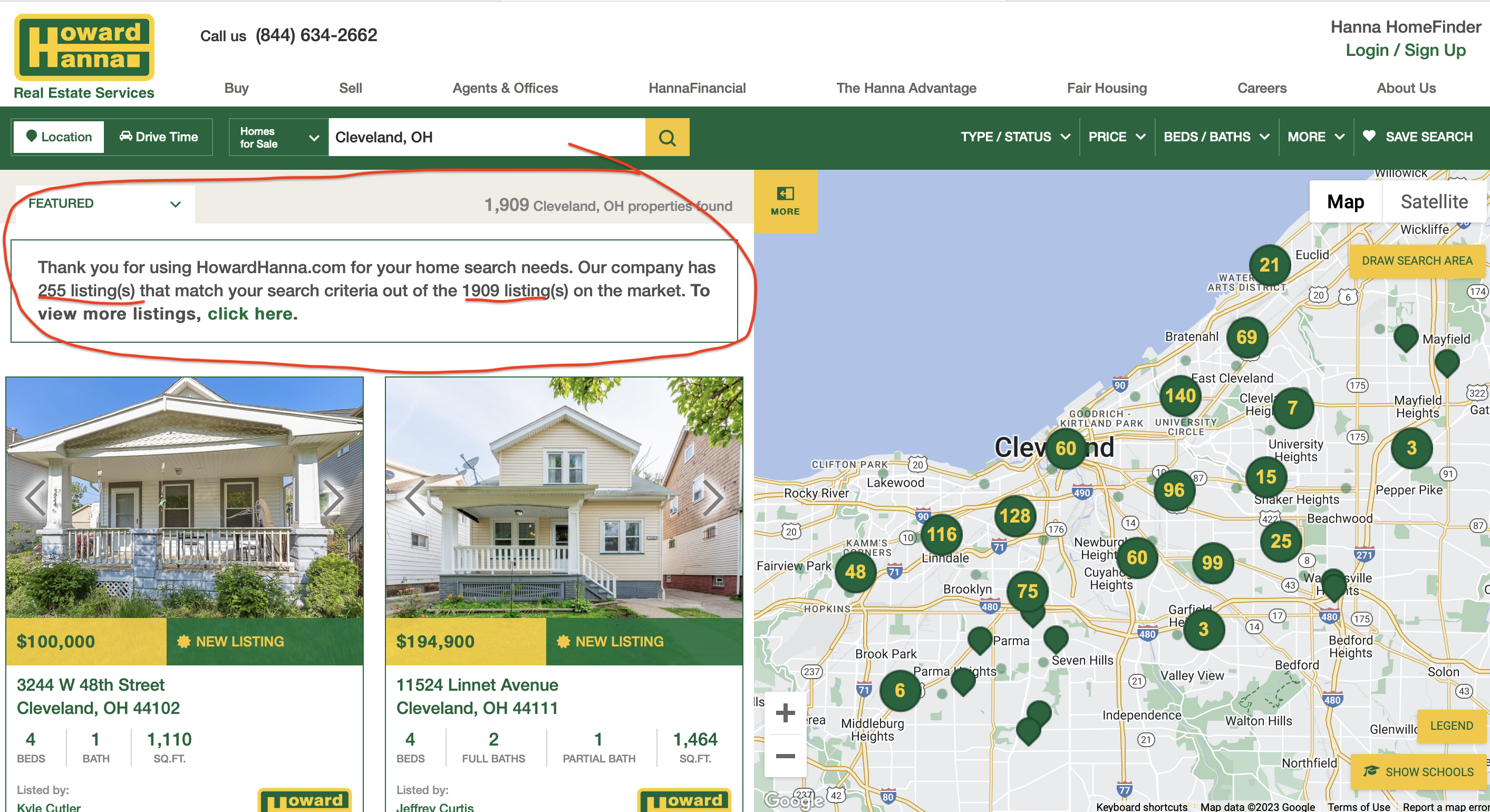
HowardHanna.com switches to VOW, and raises questions on IDX and national portals

This is a head-scratcher. I’m not sure I fully understand what is going on here but I’ll try and explain. From the video, HowardHanna.com appears to be leaving IDX. Currently, they are showing only HH listings and you must register to see more.

So is Howard Hanna pulling out of IDX? Is there some sort of selective listing opt-out mechanism? Mr. Hanna also says they will “still be partnering with the national portals, and figuring what the strategy will be with them.” I can’t for the life of me figure out how since most of the national portals use an IDX feed. Can you blend an IDX feed with a direct feed from a broker?

Genius or bat-shit crazy? I don’t yet understand the strategy fully until some of these questions are answered. I guess if they are super dominant in that market then it might make sense.

But if I’m a listing agent in Ohio that is competing with Howard Hanna the first thing I would bring up at a listing presentation is something to the tune of, “Howard Hanna won’t promote your listings on all websites, I will”.

I’ll be hosting a Twitter Spaces on this subject today at 1PM PT. Join us!

“My listing, my lead is a scam”

Great thread on Twitter from @gregfischer

It seems like everyone chimes in on this thread. Good discussion and I think Greg is spot on with some of his observations (including the one above).

Sponsored By Lone Wolf Technologies