Where Real Estate Gets Its Dirt

IT’S WAR! 6 MLS orgs file suit against Compass

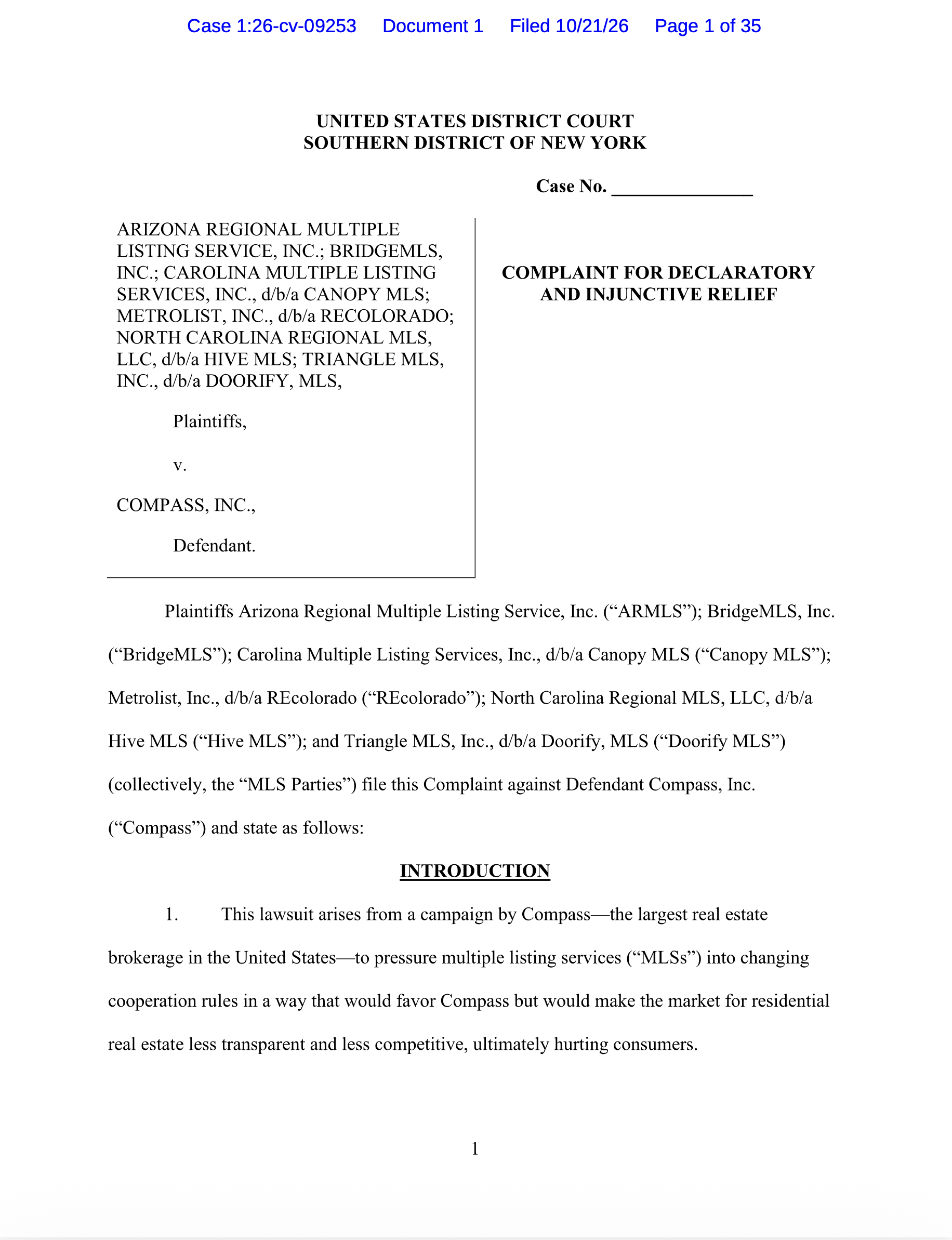
Case 1:26-cv-09253 Complaint for declaratory and injunctive relief.

“This lawsuit arises from a campaign by Compass- the largest real estate brokerage in the United States to pressure multiple listing services (“MISs”) into changing cooperation rules in a way that would favor Compass but would make the market for residential real estate less transparent and less competitive, ultimately hurting”

Holy Shit, its on.

Should Sellers Pick Pocket Listings?

The Industry Relations Podcast is now available on your favorite podcast player!

Overview

This week, Rob and Greg are joined by Professor Darren Hayunga of the University of Georgia to discuss his research on pocket listings and private sales. Using 20 years of Dallas-Fort Worth MLS data, Darren explains why his findings challenge conventional wisdom about off-market transactions, how Clear Cooperation Policy impacted pocket sales, and why sellers may not be sacrificing value by avoiding the open market. The conversation explores market efficiency, buyer and seller behavior, luxury listings, and the broader implications for the ongoing industry debate around private listing networks and consumer choice. 

Key Takeaways

  • Professor Darren Hayunga’s study found that pocket sales in Dallas-Fort Worth generated an average premium of roughly 1.7%, with luxury properties showing significantly higher premiums. 
  • The research suggests sellers may benefit from avoiding what Darren calls the “negotiation tax” associated with traditional MLS listing strategies. 
  • Clear Cooperation Policy largely eliminated the pricing advantage of pocket sales, but did not eliminate their use. 
  • Pocket listings became more common over time, growing substantially after the early 2010s despite industry efforts to curb them. 
  • The discussion highlights the challenges of measuring off-market transactions and the importance of comparing truly comparable properties when conducting housing research. 
  • Rob and Greg debate whether the continued popularity of private sales reflects consumer preference, brokerage incentives, or broader market efficiencies.

Links

Contact Professor Hayunga

Pocket Sales in the Housing Market: Selection, Outcomes and Policy

Connect with Rob and Greg

Rob’s Website 

Greg’s Website 

Watch us on YouTube

Our Sponsors:

Cotality 

Notorious VIP

The Giant Steps Job Board 

Production and Editing Services by Sunbound Studios

A field guide to the private listings laws

Anthony Mannino wrote a tidy little explainer over at HousingWire, and if you’ve been trying to keep the state-by-state private listings rules straight, this is the one to bookmark. The laws are piling up. Connecticut just passed one. New York’s bill is almost across the line. Wisconsin and Washington already did it. Hawaii and Illinois are loading up for January.

Mannino sorts the whole mess into three buckets, and the buckets are the useful part.

Washington went with the mandate. List it publicly, period, unless there’s a real safety or privacy reason not to. No form, no signature, no disclosure to bury. Public exposure is just the default.

Connecticut and New York went with the opt-out, with the legislature writing the warning right into the statute. Here’s a taste of Connecticut’s language:

“The Seller understands that foregoing public marketing may reduce competition for the property, may result in fewer offers to purchase the Seller’s property and may adversely impact the final sale price and terms of the sale of the Seller’s property.”

Wisconsin and Illinois also went opt-out, but punted the actual wording to the associations and agencies. Mannino’s point on this is the sharp one. A warning written into law is hard to change. A form drafted by an agency is easy to change, which means it’s also easy to lobby.

And then he asks the question I’ve been asking. Do these opt-out forms actually stop anybody?

“…opt-out forms may prove to be more of a liability protection for brokerages than an impediment to executing a private listing strategy.”

There it is. He calls it “warning fatigue,” and anybody who’s sat at a closing table knows exactly what he means. You hand a seller a stack of agency agreements, consumer notices, and affiliated business disclosures, then slip in one more “the government makes me tell you this” page, and it gets signed with everything else. It doesn’t change behavior. It just protects the brokerage when the seller complains later.

Which is why Washington’s model is the honest one. If you actually believe public marketing is better for sellers, you make it the default and let people opt out for cause. You don’t make sellers initial a warning nobody reads and call it informed consent.

A form you can ignore isn’t a guardrail. It’s a receipt.

Limited exposure, limited how?

Compass chief economist: The off-MLS marketing debate is ignoring 1.4M listings

I’ve known Mike Simonsen for a while, and catch his market update videos often. Here’s his argument in this Inman News piece: nearly 1.4 million homes were withdrawn from the MLS in 2025, which proves sellers already want limited exposure. So Compass didn’t invent off-market marketing. It built a structured version of what agents were quietly doing all along. He even gives it a stat, “days off market,” or DOFF. Love a good acronym and this one is great!

But, here’s the line I keep chewing on:

“What nobody is talking about is the 1.4 million listings that demonstrate how often sellers seek periods of limited exposure during the selling process.”

The word doing all the work is “exposure.” And it’s pulling double duty.

There’s exposure as time, how long a home is visible. And exposure as audience, how many buyers can see it. Withdrawals are a time move. Sellers pull the listing to reset days on market, repaint the kitchen, wait out the holidays, then relaunch. Mike’s own piece calls those windows “total invisibility.” That’s not limited exposure. That’s zero, on a timer.

Compass private listings are an audience move. The home stays for sale. Only a slice of buyers gets to see it.

So he’s collecting time-axis evidence and spending it on an audience-axis product. A withdrawal defers exposure. The seller still lands in front of everyone when it relists. A private listing forecloses it. Plenty of those buyers never see the place at all.

And if 1.4 million sellers really are begging for a pause, the clean fix isn’t a private network. It’s an MLS “coming soon” or hold status that stops the DOM clock while the listing stays wide open to every buyer. That’s a feature your MLS can ship. Funny how the data points there instead.

Sellers may want a pause button, not a velvet rope.

Zillow Wins Preliminary Injunction – MRED Must Restore IDX and VOW Feeds

Judge orders MRED to restore Zillow listing feeds in Chicago

“In an emailed statement, a Zillow spokesperson told HousingWire, that the ruling on its motion was “an important first step for the Chicago home buyers, sellers and agents who have been harmed by a coordinated scheme between MRED and Compass to reduce transparency in the housing market.” 

“In the middle of a housing affordability crisis, powerful industry players colluded to hide listings, suppress competition and steer consumers toward a single dominant brokerage,” the spokesperson wrote. “The court immediately recognized what was at stake, not just for Zillow, but for every person trying to find or sell a home across Illinois and beyond. We will continue to fight to ensure this anti-consumer conduct is not allowed to take root permanently.”

Welp, it looks like Mr. Reffkin will need find a place to store his billboards.

DAY 2

Did MRED Blink?

I’m not sure of the particulars of how the feeds work, and I know that some Chicagoland brokerages have already worked out sending listings directly in to Zillow. But this listing (from Keller Williams) this morning appears to be new, “1 minute on Zillow” and source is MRED. There are several others as well.

Did MRED back off on its threat to shut down Zillow’s IDX feed?

Anybody have the scoop?

NWMLS Isn’t Just Playing Defense Anymore

NWMLS Files Counterclaim in Federal Court

“We are standing up for the principle that every family has the right to see every home for sale, because housing data belongs in the sunlight, not in a private vault.” — Justin Haag, NWMLS CEO

Well, that didn’t take long.

Two weeks after Judge Jamal Whitehead denied NWMLS’s motion to dismiss — ruling that Compass had plausibly alleged antitrust violations under both the Sherman Act and Washington’s Consumer Protection Act — NWMLS has done exactly what it telegraphed back in December: filed counterclaims against Compass in federal court.

And they didn’t come in with some polite procedural filing. They came in throwing haymakers.

The counterclaims allege that Compass’s “3-Phase Marketing Program” violates Washington’s Consumer Protection Act — calling it a deceptive scheme designed to manipulate and hide critical data from the public. NWMLS is essentially arguing that pocket listings aren’t innovation, they’re consumer fraud. The specific allegations are pointed: artificially resetting days-on-market and price history to deceive buyers, suppressing the natural auction effect that gets sellers the best price, and actively encouraging Compass agents to violate their professional agreements.

That last one, contractual interference, is a big deal. NWMLS is saying Compass didn’t just build a competing system, it incentivized its own brokers to break their commitments to the MLS. That’s not a policy disagreement.

Here’s the part that really changes the game: NWMLS points out that Washington’s Senate Bill 6091, which takes effect this June, codifies the exact transparency standard NWMLS has enforced for decades — brokers must market properties broadly to the public and all other brokers. In other words, the state legislature looked at this fight and picked a side. And it wasn’t Compass’s side.

For those keeping score at home: Compass sued NWMLS in April 2025, alleging the MLS was a monopolist wielding its listing rules to crush Compass’s private listing strategy. NWMLS tried to get the case thrown out. The judge said no. And now NWMLS is swinging back — not just with “we did nothing wrong” but with “what you’re doing is illegal, deceptive, and bad for consumers.”

This is the first time an MLS has gone on offense against Compass in court. For years, the industry debate around private listings and Clear Cooperation has been fought through rule changes, press releases, and conference panel shade. Now it’s depositions and counterclaims.

The trial is set for October 2026, and with SB 6091 going live in June, Compass is about to be fighting a legal battle and a new state law at the same time. In the same state.

October is going to be fun.
Compass add new lawsuit, this time its Zillow

Compass sues Zillow over private listings policy

“Compass filed a lawsuit in New York on Monday, alleging that Zillow is breaking federal antitrust laws by permanently banning any listing that isn’t put on an MLS within a business day of being publicly marketed. 

“To protect its market dominance, Zillow has retaliated against competitive threats by enacting an exclusionary policy,” Compass argued in its lawsuit.”

Compass is already suing MLS organizations like NWMLS. Even in this industry the blustering that Reffkin is performing would put a carnival barker to shame.

All MLSs already have mechanisms to protect sellers who need confidentiality. To suggest otherwise is just false.

The real question is: does limiting exposure to a handpicked group of “right” buyers help most sellers? Maybe—if the home is ultra-unique. But for 99.9999% of listings, broad exposure is what gets results.

Remember the story of a seller using Compass’s “three-phase plan” who got her “magic number,” declined, then went public—and sold for $100K more.

Compass is selling a marketing strategy that only works in a hot market. As things cool or shift to a buyer’s market, that approach collapses.

Also worth noting: per NAR, 1 in 6 minority homebuyers reports facing discrimination. Does anyone really think keeping listings hidden improves that?

Rob Hahn calls bullshit on Compass claims

Compass and Coming Soon: Not About the Client

“If the Governing Principles to the Compass Agreement had read something like “Agent must use “Coming Soon” with those sellers who understand the pros and cons of the program, have privacy concerns, or other extenuating circumstances, first activating those listings for 5 days internally…” then there is some basis to think that maybe the policy really is about providing flexibility to the seller.

But the way the Agreement spells things out, it is crystal clear that Compass doesn’t care about the seller in the least bit. In fact, I’m not even sure that Compass cares about the fiduciary relationship between the Agent and his or her sellers. I mean, how likely is it that every single seller of a Compass agent would benefit from “Coming Soon” that is exclusive to Compass for a minimum of 10 days?”

Someone sent a copy of Compass’ Independent Contractor Agreement to Rob and its a doozie. Apparently, if I’m reading this right, a Compass agent under this agreement must put their ALL their listings in the in-house Coming Soon/Pocket Listing process or they lose their splits and perks.

For some reason “Cory” left that little nugget out of in their “pre-litigation” letter to Bright MLS.

Here’s Rob again about Compass’ claims…

“ “All of Agent’s sellers” puts the lie to the various excuses offered up that Coming Soon is really about client service. A “Coming Soon” strategy that is about the seller would never be a blanket one-size-fits-all policy, but one that makes certain that the seller is well-informed and is voluntarily choosing the strategy fully aware of the risks and rewards involved.

What a disaster.

#PutItOnTheMLS

Sponsored By Lone Wolf Technologies