Where Real Estate Gets Its Dirt

Canva is eating real estate marketing

Introducing the Adwerx x Canva Integration

“Agents who design their own creative in Canva have always had to bridge a gap between where they create and where they advertise. That gap is now closed.”

Adwerx is just the latest vendor to hop on the Canva train. And what a train it’s become. Keller Williams inked a deal in June of last year. Anywhere followed with an enterprise deal a month later. Rechat launched its integration in March. Lofty in May. LeadingRE added Canva to its Solutions Group program just last week. And now Adwerx.

Remember when every vendor in this industry built their own design tools? Every CRM shipped with a “design center” full of clip art templates that agents opened exactly once. That fight is over. Canva won it. It seems the smart play now is exactly what Adwerx is doing: concede creation, keep distribution. Let agents design where they already design, and make your product the place that money gets spent. (For what it’s worth, the Adwerx version is well done. One-time authorization, pull designs straight from your Canva library, auto-sized for each placement, works with free Canva accounts, no extra cost.)

But here’s the detail worth watching. Canva now has a “Head of Real Estate GTM Sales.” Companies that size don’t build dedicated real estate go-to-market teams for shits and giggles. And Canva has already launched its own MLS-integrated marketing tools. So every vendor plugging into Canva is also feeding the platform that keeps building one layer closer to their business.

Defaults matter. I’d spend the extra money and hire a good designer to make those client facing materials as good as they can be, keeping your aesthetics and vision intact. Most users will use the standard reports/materials your app ships with.

Design isn’t just about how something looks, but how it works. Having a workflow of sending your customers outside your product to another product and then come back doesn’t sound like a good experience for anyone.

It’s all about tradeoffs.
Hey Lucy, Do My Data Entry

Rechat Wants Agents To Ditch The Keyboard For Its AI Assistant, Lucy

“Agents have never enjoyed typing notes into a CRM. We ask people who sell with their voice to sit down and type, then blame them for not doing it. Hey, Lucy does the data entry for you. An agent walks up to a listing, says a few words, and the work gets done instantly.”

— Audie Chamberlain, VP of Strategic Growth and Communications, Rechat

I’m still a bit hesitant to say voice entry will be the primary way we interact with computers, I’ve written about it before. But, there is a lot of evidence that it will be. And lots of companies are betting on this. And the industry has been trying to solve “agents won’t update the CRM” for as long as I’ve been in it. Rechat’s answer is to stop asking them to type at all.

The campaign itself is the interesting part. Spots run 15 to 60 seconds, shot handheld in natural light, no narration, no feature lists. Just agents at listings, in cars, at open houses, talking to Lucy while the work gets done. That’s a confident way to sell software. Although I have no idea the quality of the CMA (or other output) it creates. I imagine them to be designed with the assumption they will be consumed on a mobile device.

Unlike some legacy apps Lucy isn’t some ChatGPT-era rebrand or bolt on. Shayan Hamidi has been building toward this since before “AI assistant” was a required slide in every pitch deck.

First Real’s HeyLeo, now Hey Lucy. Every platform’s AI is on a first-name basis with us now.

The ads run through the end of summer on Meta, Google, and national sites. If the demos hold up in the field, great. If not… Lucy, you got some ‘splainin’ to do.

Everybody’s fighting over supply

The Buyer Listing Service

Look at where all the energy is going right now. Private listings. Walled gardens. Google plugging into MLS supply. MLSs suing each other. Every fight in this business is a fight over the same thing, which is who controls the homes for sale.

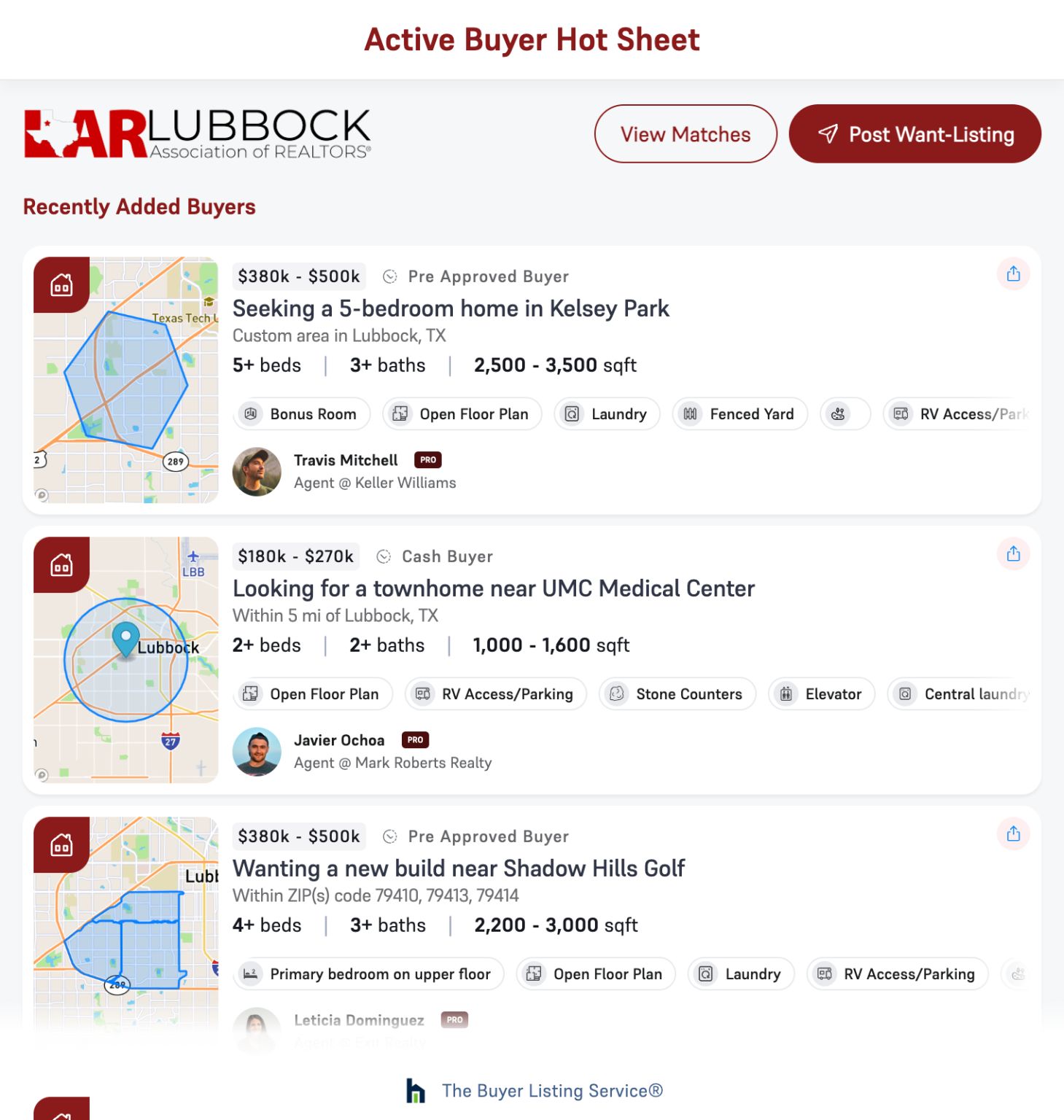
So Dan Cooper and the Gitcha crew zigged. They built a listing type for the other side of the trade. Not the houses. The buyers.

They call it the Buyer Listing Service, and the core unit is a Want-Listing. Location, property type, budget, financing, timeline, buyer agreement status. Structured buyer demand, published into the MLS, visible to the whole network. Here’s their line:

It’s not a search. It’s a listing for buyers.

Dan and his team and Gitcha came back on my radar with a LinkedIn post on their “𝗔𝗰𝘁𝗶𝘃𝗲-𝗕𝘂𝘆𝗲𝗿 𝗛𝗼𝘁 𝗦𝗵𝗲𝗲𝘁 𝗗𝗮𝘀𝗵𝗯𝗼𝗮𝗿𝗱 𝗪𝗶𝗱𝗴𝗲𝘁.” 

I’m here for it. While everyone else is busy hiding supply, Gitcha is publishing demand. A buyer listing is the structural twin of a pocket listing, and that’s the smart part. In a world where the supply side goes quiet, the leverage shifts to whoever knows the buyers. They’re building the answer to the problem the rest of the industry is busy creating.

The CMA angle is the one that got me, and this was my turf. Their pitch to listing agents is “walk into the listing appointment with data nobody else has.” Active buyer count, price clustering, demand trends. Their line: “CMA shows what sold. This shows who’s buying right now.” A CMA is a rearview mirror. This is the windshield. If it actually works, that’s a real reason to walk in the door.

It’s early. Three MLSs so far. Lubbock in April, MIBOR later that month, Momentum in western Arizona in June. The tell to watch is the vendor integration. Gitcha claims it’s already working with 4 of the top 5 MLS vendors to embed this natively. If that ships, this gets interesting fast. If it doesn’t, it’s another good idea on three dashboards.

You don’t change this industry from a breakout session. You change it by building the thing nobody asked for yet. And nobody ever wins big betting on the establishment.

Going dutch with “nora”

MetroList and Lundy Launch “nora,” Ushering in a New Era of Personal AI Assistants

MetroList, the biggest MLS in Northern California, teamed up with Justin Lundy’s crew to launch an AI assistant named “nora“. She’ll read your email, run your calendar, answer MLS rules questions, dig through property data, and help with forms and transactions. The usual personal-assistant wish list, now with an MLS behind it.

Here’s the part that caught my eye:

“nora operates on a wallet-based system powered by Stripe. MetroList-specific features are provided at no charge to MetroList subscribers, while other services such as email reading, calendar management and other advanced task execution functions are micro-transactions to get tasks done.”

So the MLS picks up its tab. Everything else, you’re going dutch.

I think this is the front edge of something. LLMs cost real money to run, and every task nora does burns tokens. The flat per-seat SaaS price is about to get company. Call it usage-based pricing, the AI remix. Load a wallet, spend as you go, top it up when it runs dry. Same energy as the arcade, except the tokens buy task completions. Get used to it, because nora won’t be the last vendor to price this way.

Then there’s the other thing. I haven’t seen a company build real estate business tools and then stroll straight into everyday consumer territory like this. Reading your email and running your calendar is Siri’s job. Alexa’s turf. A vertical real estate tool just signed up to compete with the assistant already living in your phone. Bold.

Credit where it’s due. MetroList has been quietly stacking up Lundy products for a while, and they tend to ship before the rest of the industry finishes its committee meeting. I like that somebody’s running the experiment instead of writing a white paper about it.

Nora looks sharp. Now we find out how agents will respond.

Fixing Home Affordability One Room at a Time With Atticus LeBlanc of PadSplit

The Listing Bits Podcast is now available on your favorite podcast player!

Overview

Greg Robertson sits down with Atticus LeBlanc, founder and CEO of PadSplit, to discuss the affordable housing crisis and how room-by-room rentals can create housing opportunities for people who are priced out of traditional apartments. Atticus shares his journey from commercial real estate broker to housing entrepreneur, the origins of PadSplit during the Great Financial Crisis, and how the company has grown from a single prototype house to more than 33,000 beds nationwide.

The conversation explores shared housing, affordability challenges, real estate investing, and the role technology can play in expanding access to housing. Key Takeaways Atticus grew up in New Orleans, studied Architecture and Urban Studies at Yale University, and credits competitive swimming with teaching resilience and persistence. After entering commercial real estate during the early stages of the housing crash, he discovered an overlooked opportunity in room-by-room housing. A chance encounter with tenants Mitch and Otis led to his first rooming-house experiment, revealing strong demand from renters who couldn’t qualify for traditional apartments.

PadSplit was founded in 2017 to provide the operational and technology infrastructure needed to make shared housing scalable. The platform functions similarly to Airbnb, connecting hosts with renters while handling marketing, screening, payments, move-ins, and support. Many PadSplit residents are workers earning modest incomes who are unable to meet traditional apartment qualification requirements despite having stable employment. The company has grown from 82 beds in 2018 to roughly 33,000 beds today. Shared housing can help homeowners offset mortgage costs and create pathways toward real estate investing.

Atticus argues that local market knowledge often matters more than national data when identifying successful housing opportunities. The average PadSplit resident stays about nine and a half months, though many remain for years due to the affordability and stability the model provides.

Links

Padsplit

Atticus on LinkedIn

Sponsors

Aligned Showings — MLS-owned showing software built to simplify scheduling, improve communication, and keep MLS data where it belongs.

Giant Steps Job Board – Built for organized real estate and PropTech, not generic tech bros and recruiters who don’t know what an MLS is.

Production and editing services by: Sunbound Studios

Introducing the MLS Channel Field Guide from Giant Steps

We Built the Field Guide We Wish We Had 20 Years Ago

If you’re a proptech company trying to sell into the MLS channel, you already know the basics: it’s complex, it’s slow, and nobody picks up the phone.

What you might not know is exactly how complex, how slow, and why nobody picks up the phone. That’s the part that takes years to figure out. We know, because we spent decades figuring it out ourselves.

Today we’re announcing something we’ve been working on for a while: The MLS Channel Field Guide.

I spend a lot of time speaking to new vendors and other vendors who may have been selling directly to brokers or agents who were curious about partnering with the MLS channel as a way for distributing their product. I’ve distilled all those conversations in to a presentation which I think does a great job of informing anyone new to the space. If you interested please go read the full blog post on the Giant Steps Advisors website and Let’s Talk.

From Pixels to Property Intelligence with Dominik Pogorzelski

The Listing Bits Podcast is now available on your favorite podcast player!

Overview

Greg Robertson is joined by Dominik Pogorzelski from Restb.ai to discuss the evolution of AI in real estate—from early photo tagging to large-scale property intelligence. They cover how AI is now embedded in MLS workflows, powering listing input, compliance, and valuation, while also exploring the challenges of scale, accuracy, and the future of AI in the industry. 

Key Takeaways

  • Restb.ai has been AI-first from the start, building on early computer vision models before the current AI boom. 
  • Their tech automatically tags listing photos, generates captions, and flags compliance issues during listing input. 
  • AI is deeply integrated into MLS workflows, improving listing data quality and agent efficiency. 
  • Scale matters: they process ~1.5B real estate images per month, making speed, accuracy, and cost critical. 
  • Specialized computer vision models outperform general LLMs for image tasks at scale. 
  • Compliance is a key use case—detecting prohibited elements and AI-manipulated images in listings. 
  • New regulations around altered images are increasing the need for detection and transparency tools. 
  • Expansion areas include valuation, appraisal workflows, insurance, and broader property intelligence. 

Links

Sponsors

Aligned Showings — MLS-owned showing software built to simplify scheduling, improve communication, and keep MLS data where it belongs.

Giant Steps Job Board – Built for organized real estate and PropTech, not generic tech bros and recruiters who don’t know what an MLS is.

Production and editing services by:

Sunbound Studios

GEM Soirée at Greg & Dan’s studio in Orange County, January 12th

Drew Meyers reached out and asked if we were willing to host another GEM Soirée at our studio in Orange County. We happily obliged. See below for details.

“The GEM Soirée series continues in Orange County, this edition co-hosted with Coleton BoyerGreg Robertson and Dan Woolley. An evening to mingle and celebrate the industry’s progress with real estate tech founders, execs, VCs & angels, and practitioners. Hang with the cool kids of proptech and organized real estate at Greg Robertson’s and Dan Woolley’s studio (aka mancave) in Costa Mesa, CA. A proper mingling of the sharpest mind in real estate tech with great foodcocktails, and a soundtrack that doesn’t suck. Alcohol and o’dourves will be provided.”

Hope to see you there! Great way to find out more about GEM and meet others in the proptech space.

Please follow this link to register for the event = > GEM Soirée in Orange County

All in

From Vegas to venture capital: Navigating the uncertain path of the proptech founder

“I think as a founder, what I have found through this journey is almost every couple of months I have to be a different CEO,” Reddy said. “Like I have to be a completely different person because what was needed from me for the company a few months ago isn’t what we need today because we’re inherently shifting, evolving, scaling as the industry goes.”

A great read from Craig Rowe at Inman News. Really captures the struggles of being a founder in this space. I know a lot of the people and companies he is talking about.

Hat tip to Vanessa, Scott, Terrance, Malte, Vijay, Andy, Greg, Alex, Dan, Audie, Shelia, and many others You guys all inspire me. And a special shout out to Cole Boyer with Tuesday. LFG!

Proptech Pre-Party was a huge success!

We had some old friends show up and made some new friends. Thanks to all that came including: Cole Boyer, of Tuesday, Micheal Alladawi from Revive, Alex Gustafson from Oppy, Devin Dvorak from Jointly, Cesar Macias of RPR, Daniel Ortega from ICE, Alisher Akhmetkaliyev and Kanatbek Sagitzhan also from Tuesday Jeremy Henley from TheQwikFix and many more!

See you in San Diego!

Sponsored By FBS