Super fun to join James and Keith on their pod, Real Estate Insiders Unfiltered Podcast. I was just happy to have some backup on my conversations with Rob.
“Put it in your ears kids!”
The Industry Relations Podcast is now available on your favorite podcast player!
Overview
Rob and Greg break down Open Real Estate (ORE), a new initiative from eXp, Real, RE/MAX, Keller Williams, and Berkshire Hathaway HomeServices to build a broker-run listing cooperative. They debate whether ORE is a national MLS or a syndication platform, whether a Q1 2027 launch is realistic, and what ORE could mean for MLSs, Compass, and government regulation of the industry.
Key Takeaways
Links
Vendor Alley: Upstream 2.0? Not Quite.
Inman: KW, AGNT, HomeServices of America, Real REMAX fight private listing with new collaboration
BAM (Video) : REAL, eXp, Keller Williams & Berkshire Hathaway Announce Historic Team Up
Notorious POD (Video): Reaction Video – Open Real Estate
Are you an MLS Exec going to NAR NXT? Book a meeting with Greg/Giant Steps
Connect with Rob and Greg
Watch us on YouTube
Our Sponsors:
Production and Editing Services by Sunbound Studios
KW, AGNT, HomeServices of America, Real, and RE/MAX Fight Private Listings With New Collaboration
“This effort is bigger than any one company.”
Keller Williams, AGNT (eXp and NextHome), HomeServices of America, Real, and RE/MAX launched Open Real Estate today, with Brown Harris Stevens, Lamacchia, Samson, and Windermere signed on as participating members.
One thing I love is that they dropped the news right before Compass’ annual retreat. Now Reffkin will be on stage trying to defend his bullshit “Seller’s Choice” narrative against a backdrop of multiple lawsuits, inquiries from local, state, and national politicians, and some of the largest real estate firms in the business advocating for transparency and consumers. And some Compass agents are already losing faith. Who wants all this drama?
Okay, back to the announcement. After reading a bunch and watching this video, here’s what I’ve come up with.
The idea (not the execution) is simple. A broker enters a listing once, using standard fields, and it goes to every member brokerage, the local MLS, portals, appraisers, and data services. The listing has to be in the database within one business day of the listing agreement being signed. The listing broker then picks “Market,” which is public, or “Participant,” which only agents at member brokerages can see and nobody can market publicly.
A submission deadline, and every member sees every listing. That’s a cooperation rule. This time, the brokers wrote it.
Here are some high-level takeaways:
I can see why they’re doing it. Brokers are running on razor-thin margins and looking for ways to replace lost commission revenue. Several of these firms wrote big checks to settle the commission lawsuits after NAR lost Sitzer-Burnett. And all of them have spent years dealing with hundreds of MLSs, each with its own rules, fields, and fees.
If your listings are your most valuable asset, building your own pipe and getting paid for what flows through it makes business sense. Who could blame them? Although it’s not that easy.
From what I understand, you need a complete dataset for anyone to be truly interested. Not 25%, not 50%, not 75%. And these firms aren’t there.
As I’ve stated, I don’t think these firms were particularly happy with how some MLS organizations bent the knee to Compass. But I do see something that might help many MLSs.
Since the settlement, NAR has been “de-risking,” pushing MLS policy decisions down to local MLSs. That leaves a lot of MLS executives defending rules on their own. A national group of big brokers with its own cooperation standard might be just the ticket for MLSs tired of making up excuses.
I could see Open Real Estate starting to charge MLSs for listing data, and not every MLS will be able to pay. The big ones will. The smaller ones might not, and that could set off another round of consolidation.
But running a broker cooperative is hard. Ask any MLS executive.
Rules need enforcement, enforcement needs staff and governance, and at some point, somebody has to fine a member’s top producer.
Open Real Estate has no leadership, no staff, and no final governance structure yet. It hasn’t picked a technology partner, and the RFP process with “several national technology vendors” wraps up in Q1 2027.
I think declaring they’ll be “operational” by Q1 2027 is a mistake. And I’m not really talking about the tech.
It’s never the tech. It’s the politics.
What about BLX? I thought KW and HomeServices had already announced something tech-wise with Cotality. This all sounds very familiar.
Here’s a quote from Kevin Greene, general manager of Real Estate Solutions at Cotality, in RISMedia on July 10, 2026:
“The MLS remains the essential bedrock of the local real estate marketplace. It is the definitive environment for compilation and broker-to-broker cooperation,” Greene states. “BLX is not a replacement marketplace; it is a broker’s private portfolio management tool. The two systems work in unison. The broker gains deep visibility into their own internal business inventory across their regional or national footprint, while the MLS continues to provide the comprehensive, hyperlocal market intelligence that every agent needs to advise clients and close transactions.”
Will Open Real Estate sync both ways the way BLX does? Leo says yes in the BAM video.
Again, I’m skeptical.
And what about Compass?
Back in February Robert Reffkin floated a national listing platform jointly owned by a coalition of brokerages, with “no disproportionate ownership” by Compass and an independent board.
Today, his biggest competitors launched something that looks a lot like it.
He just isn’t on the cap table.
On paper, Open Real Estate runs straight at his exclusive-listing strategy: Get it in within a day, and every member sees it.
But that strategy has brought Compass plenty of headaches and lawsuits. If Reffkin is looking for a way out, could a broker-run cooperative that isn’t an MLS be it?
Joining means playing by his rivals’ rules. Staying out means fighting them on another front.
Lots for him to think about.
Right now, it’s a letter, a website, and eight logos. It’s an interesting idea with a lot of hard parts left.
By Q1 2027, we’ll know whether it’s a platform or a press release.
In Its Own Words: What Compass’s Lawsuit Reveals About Itself
CRMLS’s Art Carter and Ed Zorn sat down with Compass’s antitrust complaint against them and read it slowly. They stopped at paragraph 3:
“One reason homeowners like having this choice is that they can use pre-MLS public marketing to test the price of a home with real-world feedback from agents and their clients, which helps ensure the home is not overpriced when it lists in the MLS…”
Compass says about 48% of its sellers used this “phased marketing” where their MLS allowed it.
Last week I wrote about paragraph 76 of the six-MLS complaint, which says Compass agents build their CMAs on everybody else’s comps. Turns out that’s only half of it. According to Compass’s own complaint, about half its sellers also need everybody else’s agents to tell them what the house is worth. The comps aren’t enough. They want live feedback from the competition too, before the listing goes anywhere those competitors’ buyers can see it. Carter and Zorn ask it more politely:
“Why would a competent agent representing a seller need input and feedback from competing agents just to determine what the list price of a property should be?”
Price is the number one objection sellers raise. Compass’s answer is to let the other brokers argue it for them. Strange thing for a technology company to tell a federal judge about half its listings.
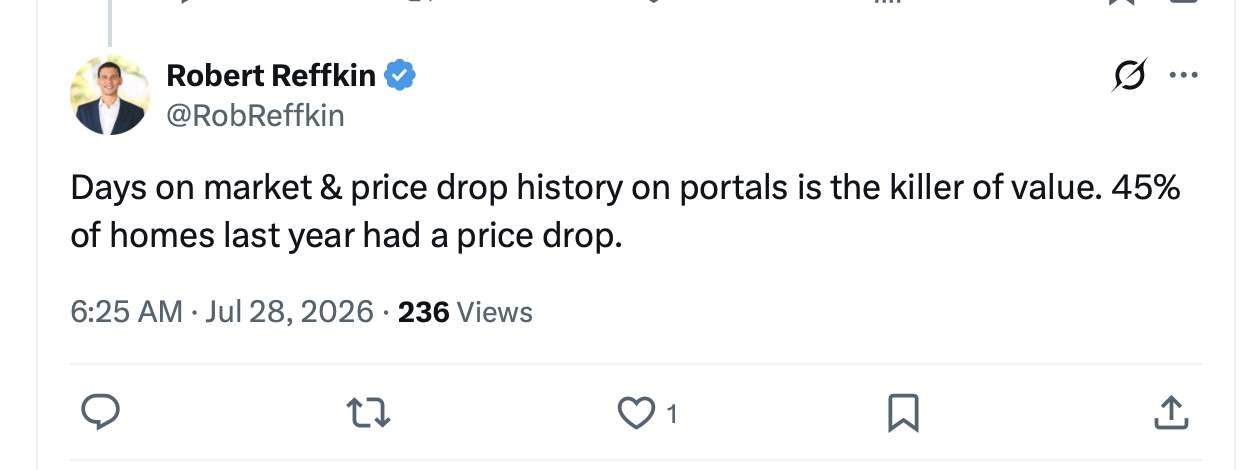
It gets worse. Same paragraph, Compass says the strategy avoids listings getting “permanently soiled by price cuts and extended ‘days on market’ that hurt the perceived value of the homes.” Zorn has been working this angle since THRIVE in September. California’s agency disclosure form (Civil Code 2079.16) says the listing agent owes the buyer a duty to disclose facts that materially affect value. If DOM and price cuts permanently soil value, they’re material. Compass just said so in a federal filing. Then it threw in the 4.6% premium its phased-marketing homes supposedly sell for, which reads an awful lot like a damages number. Hagens Berman already noticed that one in Chicago.
The fact-check section is fun too. Compass says CRMLS licenses data to portals while “paying Compass nothing.” CRMLS says it emailed Compass brokers five times this spring with instructions to collect $24,443.78 in revenue share. Compass says sellers of other goods don’t have to show price history. CRMLS posted screenshots from Edmunds (Porsche Macans natch!) and Amazon. Compass says consumers can’t get into the CRMLS database. CRMLS counts more than 12.5 million consumer logins to its client portals last year.
Yikes!
This is one side of a lawsuit arguing its case in public, and Compass’s lawyers will have answers (I’m assuming). But “test the price” isn’t a lawyer’s flourish. It’s the listing presentation.
The CMA is the price test. If you need your competitors to tell you what the house is worth, the least you can do is let their buyers see it. Last week the CMA was Exhibit A. This week Compass filed Exhibit B itself.
(Same disclosure as last week: I consult with Lone Wolf on Cloud CMA. The dog is still a very good boy.)