Listing entry that strengthens the MLS-broker connection
FBS is 100% focused on MLS success, which means solutions built around each MLS’s market, not a one-size-fits-all approach to serving the brokers and agents they work with.
That partnership shows up in the solutions MLSs can offer their brokers, from broker-directed marketing to direct access to Flexmls from the broker’s own technology tools.
FBS gives MLSs listing input and maintenance options that keep the MLS at the center, as the primary source for listing entry, while preserving the value, structure, and benefits of the MLS ecosystem. Whatever a broker’s setup, the MLS remains the rules validation engine through Flexmls, ensuring flexibility without sacrificing data quality.
Brokers get solutions for their agents, agents get to work the way that fits their operation, and the MLS still gets the complete, accurate data its ecosystem depends on. It’s how FBS builds: flexible enough to meet everyone where they are, without anyone getting boxed in.
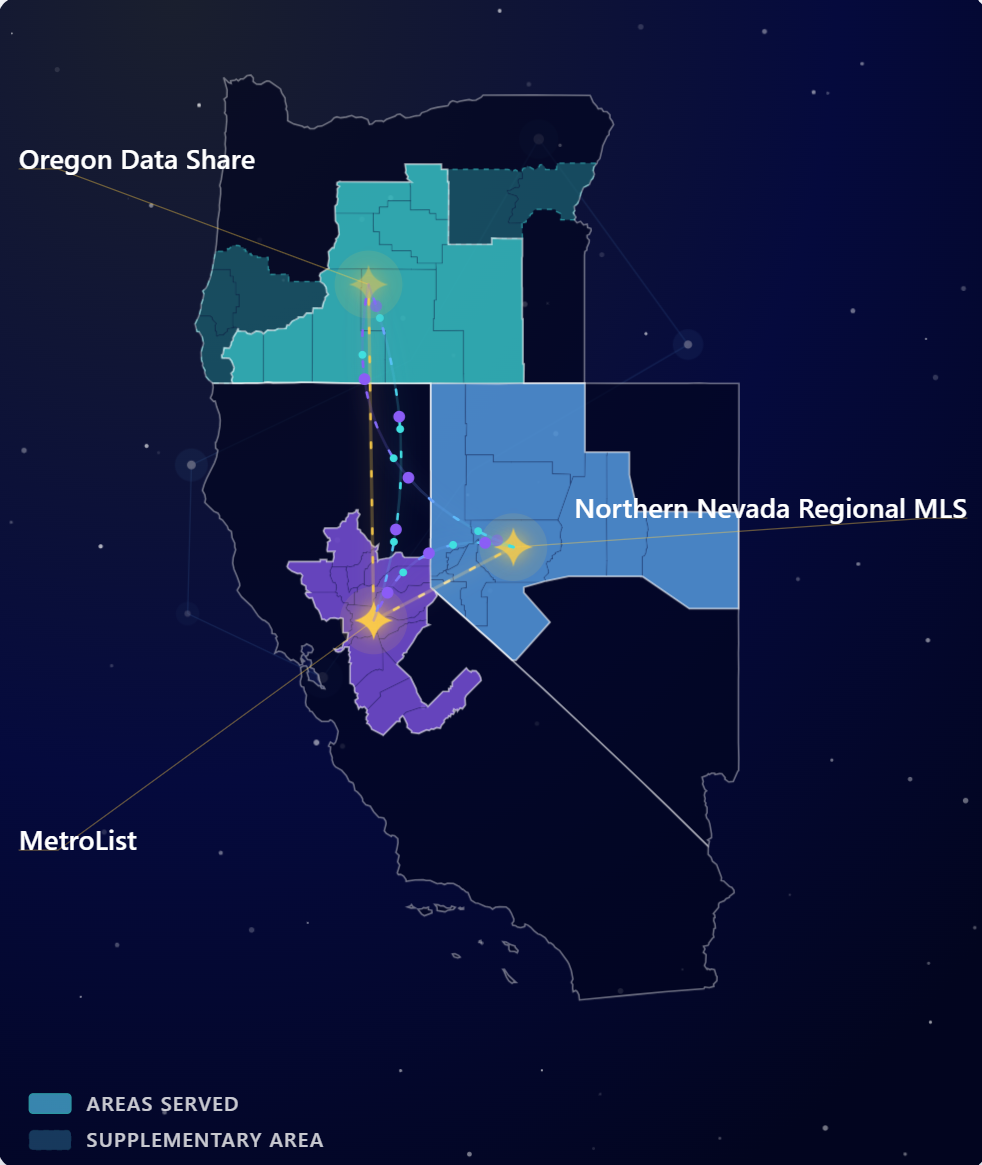
ODS founders Tina Grimes, CEO of Southern Oregon MLS, and Casie Conlon, CEO of Cascades East MLS, explained the genesis of this initiative: “Naming the initiative Orion Real Estate Data Exchange reflects our mutual vision for a borderless, data-informed real estate ecosystem. With consumer migration between Oregon, Nevada, and California, our objective is to empower our members with tools and access that help them best serve clients wherever they are.”
We’ve spent two years arguing about whether a national MLS should exist. Panels, position papers, a declaration of principles. Meanwhile MetroList, Northern Nevada Regional MLS and Oregon Data Share just built a working piece of one across three states and framed it as a service for people moving to Reno.
That’s the third one of these I’ve written up this year. Back in April the Southeast MLS Alliance added realMLS and got to 118,000 subscribers across five markets, and I tipped my hat to Joesph Cullom, because connecting the pipes without merging is the humane version of consolidation. I still think that. I’ve just started wanting to know who ends up owning the pipes.
One line in the announcement is doing more work than the rest of it combined:
“We’re starting with practical access today while building the infrastructure for a much deeper level of data sharing tomorrow.”
That’s George Pickard at NNRMLS, and the tomorrow half is the part worth reading twice.
Phase one is a shared front end. Members see listings across all three markets in Rapattoni-powered tools. Nice benefit. Not a story. Phase two pushes the data into each organization’s own primary MLS system. That’s shared infrastructure. And shared infrastructure eventually needs somebody to run it, fund it, and decide who else gets in.
Nobody’s saying who that is. No governance structure, no subscriber counts, no word on who’s funding the build. What we do get is the Rapattoni mention, and Rapattoni is the quietly interesting part. Niki Rapattoni is still running the company she and Andy started in 1970. While Cotality and most of the rest of the legacy MLS stack were getting tucked into private equity portfolios, MLS system vendors like Rapattoni and FBS have managed to stay independent. So the connective tissue for three states is now sitting on top of the one of the MLS vendors nobody managed to roll up.
And MetroList keeps shipping. I said the same thing about them when Nora launched, so at this point it isn’t a compliment, it’s a pattern. Now they’re doing it again with two neighbors and a migration stat: 129,000 people moved between California, Nevada and Oregon in 2024. That’s a refreshingly boring reason to build something. Consumers moved, so the data should follow them.
So here’s the question nobody asked at launch. In year three, who owns Orion? Phase two is when that answer gets expensive to change.
Sellers want their homes marketed on their terms. Brokers want the tools to make that happen without adding complexity to their day. FBS gives MLSs the ability to get it right for their market, with the flexibility that comes from having one partner behind it all.
MLSs set up custom data feeds that define where listings can display. Combined with options like Coming Soon, Delayed Marketing, and Office Exclusive, brokers get real say over where their listings are distributed, down to the individual listing. Brokers choose which feeds their listings are sent to, and agents use those options to serve each seller’s specific preferences.
It’s control that fits the broker’s business, delivered through the system they already know and trust, not a separate platform layered on top of it. For an MLS asking what brokers and agents actually need, that’s the kind of flexibility worth having in-house.
“A Product Manager is passionate about building products that customers love, working with cross-functional teams to design, build and roll-out products that deliver the company’s vision and strategy. You must possess a unique blend of business and technical savvy; a big-picture vision, and the drive to make that vision a reality. You must enjoy spending time in the market to understand their problems and find innovative solutions for the broader market.”
Sellers want their homes marketed on their terms. Brokers want the tools to make that happen without adding complexity to their day. FBS gives MLSs the ability to get it right for their market, with the flexibility that comes from having one partner behind it all.
MLSs set up custom data feeds that define where listings can display. Combined with options like Coming Soon, Delayed Marketing, and Office Exclusive, brokers get real say over where their listings are distributed, down to the individual listing. Brokers choose which feeds their listings are sent to, and agents use those options to serve each seller’s specific preferences.
It’s control that fits the broker’s business, delivered through the system they already know and trust, not a separate platform layered on top of it. For an MLS asking what brokers and agents actually need, that’s the kind of flexibility worth having in-house.
How can we be the best stewards of our data? It’s a question every MLS, broker, and agent is asking, and one that deserves a straight answer.
FBS believes the MLS is the true steward of its database, and brokers own their individual listings—that’s a winning combination. Their technology is built to support this, giving your team simple, effective tools to manage data based on your specific market, honor broker distribution preferences, and keep compliance straightforward with built-in tracking. With the Spark Datamart, They’ve brought licensing, approvals, and usage tracking together into one central, easy-to-use dashboard for your team. They’re also introducing new photo watermarking technology, so you can easily verify that your listing photos are being displayed exactly as agreed.
The result is a data model shaped around each MLS’s own market and its own policies, not a template FBS hands down the same way to everyone. For an MLS weighing the long-term value of its data, that’s a distinction worth understanding.
The Industry Relations Podcast is now available on your favorite podcast player!
Overview
Rob and Greg are joined by Michael Wurzer, President and CEO of FBS, for a live continuation of the IDX/data-distribution debate that started at the Columbus Realtors event and continued in a series of dueling LinkedIn posts. Rob argues the MLS should get out of data distribution and marketing entirely; Wurzer defends a reformed, usage-based IDX system; Greg plays referee. The conversation ranges from first-principles arguments about what the MLS is actually for, to pricing and licensing models, to whether a national MLS is closer than anyone thinks.
Key Takeaways
Wurzer proposes keeping IDX but shifting to volume/usage-based licensing instead of blowing up the current system
Rob argues the MLS’s only legitimate first-principle purpose is brokerage cooperation, not data distribution or marketing
Wurzer: licenses should follow use — display rights are separable from participation rights
Rob compares reforming IDX incrementally to “improving slavery” rather than abolishing it — Greg pushes back hard
Wurzer references Craig Cheatham’s writing on shifting licensing focus to how data is used, not who’s using it
Discussion of whether non-broker companies (House Canary, Zillow, OpenAI) should get separate syndication licenses distinct from broker/participant data licenses
Rob argues MLS “creates no data” — all data originates from brokers and agents (the “ultimate UGC”)
Wurzer counters that aggregation itself has independent value, distinct from the underlying listings
Debate over whether a national MLS is realistic — Rob claims only ~25 MLSs are needed to reach 85% listing share
Both agree clear cooperation as a nationwide mandate was likely a policy mistake
Wurzer references Daniel Jones (Hive) as working on a formal “MLS constitution” concept
A feature earns a headline. A habit earns its place in someone’s workday. FBS’s approach to AI is to earn that place in your workflow, building tools you’ll utilize without thinking twice.
Prefer your own AI tool? The Flexmls MCP server gives it direct, secure access to real-time Flexmls data, so you can bring the tool you already like and get answers grounded in accurate MLS data. The same connection turns an MLS’s own rules, forms, and policies into an AI-searchable resource, giving MLS staff and subscribers fast, reliable answers exactly when they need them.
Prefer a tool that works inside Flexmls itself? An AI Assistant will soon give you the ability to get answers, analyze MLS data, generate reports, and more, all without leaving the MLS system. Alongside it, Auto Assistant+ speeds up listing entry by auto-populating fields from photos and existing listing data, for quicker, more complete listings. Together, they turn the MLS into something agents actively reach for to manage their business and understand their client relationships more clearly.
Whether you’re pulling data or putting AI to work analyzing it, FBS keeps you grounded in real MLS data you can trust, built around how you already work, not someone else’s idea of how AI should feel.
If you’ve worked around the MLS industry for a while, you probably know FBS or at least one of the products they’ve built.
Flexmls is probably the name most familiar to many of us. FBS has been building technology for the MLS industry for decades, so they’ve had a front-row seat to a lot of change in this business.
This September, FBS is sponsoring Vendor Alley, and I’m happy to have them here.
If you haven’t checked out what they’ve been doing with Flexmls lately, take a look: