Where Real Estate Gets Its Dirt

35 is the new 40

First-time homebuyers, rejoice!

“There’s just one problem: The death of the thirtysomething homebuyer may have been greatly exaggerated. A new analysis from Redfin, shared exclusively with Business Insider, found that the median age of the first-time buyer last year was 35 — a slight decrease from the year prior. It adds to the growing pile of evidence that the new median of 40 was a mirage. While millennials, now 29 to 45, generally lag behind boomers on the homeownership front, the purchasing milestone hasn’t shifted nearly as much as the NAR report suggests.”

Fascinating reporting by James Rodriguez of Business Insider based on new data from Redfin and other sources. James, to me, is one of the rare writers outside the ORE bubble who seems to really get our business.

There is a bit of quibbling between NAR and other organizations that conduct surveys. But it seems the narrative might need adjusting.

“Because no data source is perfect, what you really want to do is say, What is the bulk of the evidence showing me?” Zhao tells me. “When we compare our results to analyses that other people have done looking at credit bureau data or mortgage data, it seems to support the idea that the age of the first-time buyer has not increased all that much.”

This is important because national policy is being shaped by these narratives getting out. Worth the read.

The Doctor Is In

I was in Chicago last week at NAR Headquarters for the NAR Influencer Summit. My kids got a kick out of me being an “influencer.” I feel so Gen Z! Rob Hahn was there, as was Keith Robinson from NextHome/Real Estate Insider’s Podcast, Katie Lance, and a few other podcasters/bloggers/etc. I heard there were more invited but couldn’t make it due to scheduling.

The meeting was held at the top of the NAR building on Michigan Ave. Very cool. I hadn’t been inside the building since pre-pandemic, and never to the top, so that was kind of a treat.

What struck me initially was who from NAR was present: basically Nykia Wright, CEO of NAR, and her entire executive team. Some of them, based in Washington DC, had flown in to attend the event. And they were there for the entire meeting, which lasted from 12 PM to about 6 PM. We were told nothing was off limits, but to be respectful. A lot of the executive team gave brief presentations and then we could ask questions.

Nykia was the first to present. She basically went over NAR’s new strategic plan. I had already read it, so a lot of it was repetitive. Some of the team were brand new to NAR; others had already been there a while, like Lawrence Yun, Shannon McGahn, Mark Birschbach, and Jonathan Waclawski.

Nykia spoke about roughly a 20% reduction in NAR staff, which was higher than the 14% number I had read previously. Based on the tenor of the conversations, budget pressures were clearly a big driver across many departments.

This ain’t your old NAR.

I asked a lot of questions. When I thought I was getting corporate gobbledygook, I pushed back and asked for clarification—which, most of the time, I got. There were some myths I had about NAR that were busted. Some answers I thought were incomplete. But overall I have to say I was impressed with the effort and thought that Nykia and her executive team put into it. Honestly, really impressed.

At one point Nykia described herself as a “business doctor.” I thought that was apt. She described her patient, NAR. By NAR she meant the entire ecosystem: staff, leadership, brokers, and agents. She laid out what the patient needed to do to survive. As a pragmatic doctor, there was no need to dwell on the past. The past was done. Her focus is making sure the patient survives going forward. Her beside manner? All business.

The prescription was pretty clear.

The patient needs to get sober.

Change its diet. Lose some weight.

Eat healthier foods. More greens. Fewer carbs.

And one by one, members of her executive team came up and explained how the patient would start exercising again—new routines, new disciplines, new habits meant to produce a healthier organization.
Maybe even stop hanging around with a few bad influences.

Everyone in the room seemed to agree with the diagnosis.

But agreeing with the doctor and following the doctor’s orders are two very different things.

So the real question isn’t whether NAR has a plan.

The question is whether the patient will actually follow it.

We’ll see.

But at least the doctor has arrived.

My thanks to Bennett Richardson for the invite and Nykia for her hospitality.

The Participation Award

Third Point Sends Letter to Board of Directors of CoStar Group

We thought then, as we do now, that the Company’s anemic performance can be ascribed entirely to the misallocation of billions of dollars into Homes.com, overseen by a feckless board of directors that has failed to protect shareholders from Mr. Florance’s quixotic quest while rewarding him with exorbitant pay packages. Like an elementary school child who wins a prize even for finishing last, Mr. Florance’s bonuses are perhaps the costliest “Participation Award” our firm has witnessed.

This guy, Dan Loeb, doesn’t do subtle.

I don’t know all the players but it looks like Third Point ( I’m guessing a hedge fund) is a huge investor and there was some sort of “standstill agreement” with CoStar that expired at midnight. And these guys at the hedge fund came out swinging this morning with a letter that reads like a controlled demolition. Loeb is nominating a slate of directors to replace the majority of the board, which he describes as “feckless” and “supine enablers” of Andy Florance’s Homes.com obsession( a.k.a. ZDSZillow Derangement Syndrome).

More from the letter:

The Company’s plan to build a dominant online classifieds business in the U.S. RRE industry was deeply flawed, with structural problems affecting both sides of management’s proposed two-sided marketplace. First, customer demand was dominated by deeply entrenched competitors with strong brands and ample resources. Second, and even more damaging, the Company lacked meaningful differentiation in its supply of properties due to the presence of MLS’s freely syndicated listings. While these problems were immediately obvious to any informed observer, management and the board either ignored or failed to understand them.

Ouch, that’s going to leave a mark. He’s basically saying, we liked the monopoly we owned before. We don’t believe nor did we ever believe you could establish a monopoly in residential real estate.

So CoStar has sunk roughly $3 billion into U.S. residential real estate over five years. The return? About $60 million in revenue last year. Meanwhile, Florance received $37 million in compensation despite the stock dropping 27% over five years while the S&P 500 returned 94%. No bueno according the Mr. Loeb.

Loeb’s description of Florance’s bonus as the “costliest Participation Award” his firm has ever witnessed is the kind of line that ends up in business school case studies — which, he helpfully notes, is exactly where CoStar’s residential strategy belongs.

But I’m not so sure. I keep thinking of that conversation attributed to Masayoshi Son (CEO of SoftBank) when he was talking to Adam Neumann of WeWork.

Masayoshi Son: In a fight, who wins — the smart guy or the crazy guy?

Adam Neumann: The crazy guy of course.

Masayoshi Son: Correct, but you are not crazy enough.

I’m not sure I would ever bet against Andy Florance. Isn’t “quixotic” just another word for crazy?

But it sounds like Third Point wants CoStar out of the residential real estate (RRE) business. So let’s pull on that thread a little bit.

Who do they sell it to?

Yup, you guessed it…Compass. And Reffkin is for sure crazy enough!

The education of Mr. Reffkin

Looks like CRMLS isn’t playing. They brought receipts and a little sick burn to Compass, CEO Robert Reffkin latest social media tizzy fit.

“The specific language that you recently pointed out on social media about listing control and display in the EULA has been there for years. Why that language exists requires a bit of a history lesson, so humor me as I explain how what we provide is a good thing to all parties. “

Here’s some more context

“For years, we had seen grey market activity by people who have access to the MLS selling its data to those who didn’t, which meant brokers and agents weren’t being compensated for the valuable information they provided. Conservative estimates for how much money was being made this way started at around $5 million per year, with the potential to have gone as high as $100 million. So, we saw an opportunity to monetize the data in a way that puts money back in the pockets of those who provided it. “

Think Napster

Here’s the whole thing if you want to read it. The second to last paragraph seems to indicate that Mr. Reffkin isn’t being totally sincere.

Okay, Mr. Reffkin, you got some people’s attention. You may feel like you’ve got us pinned, but the thing is, you’ve yet again ignored or refused to be bothered by some important facts.

I typically don’t get into the reeds regarding every defamatory claim about CRMLS that comes up on social media, but the misinformation you’ve spread is worth addressing and clarifying. Let’s just put things in clear terms right from the jump; CRMLS’s EULA doesn’t endorse taking control of listings away from agents or brokers or improperly profiting from them. Instead, it’s goal is to provide benefits back to the brokerage community for the listing content provided.

To begin, the most recent changes to our EULA were about two things and two things only: 

  • Multifactor authentication: Our front-end vendors wanted this security enhancement and we’re happy to install it as it optimizes our data security.
  • Appeal rights: We added a provision to ensure brokers have the right to correct issues that may arise during arbitration. 
  • And that’s it. 

The specific language that you recently pointed out on social media about listing control and display in the EULA has been there for years. Why that language exists requires a bit of a history lesson, so humor me as I explain how what we provide is a good thing to all parties. 

Systemwide Copyright and Data Protection 

For many years, CRMLS (along with many other large MLSs) made quarterly filings with the US Copyright Office to protect the MLS database and safeguard intellectual property.

However, the Copyright Office denied protection, claiming that MLS data was just a directory, meaning the information could not be copyrighted. In response, CRMLS and other MLSs worked together to educate the Copyright Office on the creative elements within MLS listings.

To prove our claim, CRMLS submitted Operations Committee meeting minutes, where dozens of our participating agents and brokers debated the necessity and purpose of every MLS data field. This illustrated the creative decision making and coordination involved in building the MLS system as the MLS determines what is part of the official listing record. 

As a result, the Copyright Office has since recognized MLS listings as eligible for protection, allowing us to better protect agents’ work from unauthorized use.

Which brings us to REdistribute…

REdistribute and Data Control 

Now that the MLS had a say on its database, we went to work trying to make new ways for the data to work for our users. For years, we had seen grey market activity by people who have access to the MLS selling its data to those who didn’t, which meant brokers and agents weren’t being compensated for the valuable information they provided. Conservative estimates for how much money was being made this way started at around $5 million per year, with the potential to have gone as high as $100 million. So, we saw an opportunity to monetize the data in a way that puts money back in the pockets of those who provided it. Thus, REdistribute was born, and language to support it was included in the EULA several years ago. 

REdistribute is an independent company born as a joint venture between MLSs. It packages MLS data for institutional use, so entities like mortgage lenders or banks can get a better concept of the real estate market. Those entities pay to license the data, and the MLS can then allocate those payments back to the brokerages who provided the data. 

This system recognizes that the value of the listing belongs to the agents and brokers who created it. It doesn’t mean that the MLS “owns” the data. If every agent were to have individual ownership of their listing, then every use of the data outside the MLS (think AVMs or IDX feeds) would require approval from all the thousands of CRMLS brokers. That’s unfeasible. The MLS manages the data in ways that benefit our users, but that data is only valuable as a set, not as a bunch of individual fragments. 

In short, CRMLS worked to protect listing data under copyright and helped create REdistribute to legally share and monetize brokerage data, allowing MLSs to bring that value back to brokers.

What This Means for Today’s Market

Now that the history lesson is over, let’s talk about what this means for agents and brokers operating today. We’re facing a shrinking market with tighter margins, so CRMLS is always looking for new ways to return value to our brokerage community. 

Have we asked for certain elements of control over listing data? Yes. Have we done it to enrich ourselves? Absolutely not. 

The systems we have in place stand to benefit all our users, regardless of brokerage size, and create an even spread of opportunities for everyone. I wish to see more of this spirit of collaboration in our industry, but that requires trust and honesty from all parties, not random jabs that are devoid of context. 

Before I conclude, Mr. Reffkin, here’s one more piece of history. In September 2023, while at the RISMedia CEO and Leadership Conference, you asked to meet with myself and CRMLS VP Ed Zorn. We were prepared for a conversation on CCP and No Cooperation Listings (aka Office Exclusives). Instead, you spent the better part of an hour discussing topics related to data distribution and the use of listing data. You asked us how we could get the rest of the country to adopt the CRMLS way of handling listings. You praised our ease of access and terms of use. You were frustrated that other MLS entities did things differently and that you had challenges getting complete listing data. CRMLS could deliver what Compass needed in the way of data due to the MLS owning the MLS listing record and only because we had the terms in our EULA that you identified in your post. That ownership allows the MLS to open up the use of the data by all members of the MLS in a consistent and fair manner.

CRMLS remains committed to transparency, accountability, and service to agents, brokers, and consumers. We will continue to focus on providing accurate information and delivering value to the real estate community we proudly represent. Rather than allowing misinformation to divide us, let’s focus on working together to build a stronger and more informed professional community. “

Reffkin pitches his fever dream idea of sharing exclusive listing data

Seller’s Choice?

Compass agrees to share its exclusive listings, with 2 caveats

“However, the NYC-based brokerage that has fiercely championed private listing networks said its offer comes with two conditions: The brokerage or MLS agrees not to alter or monetize the homeowners’ listings in any way, keeping the listing agent front and center, and the brokerage or MLS can ensure agents won’t be fined or banned for sharing listings with the brokerage or MLS.”

It sounds like they’ve closed the book on their Private Exclusive Book. That was quick. And now it seems they’re launching a new narrative about sites and MLSs that “monetize” listing data. I thought this was all about “seller’s choice”?

Honestly, it’s hard to keep track of how much shit they throw at the wall. Will they ban Google from showing their properties next, since Google monetizes search traffic? Are they banning all forms of referral compensation, or just the ones from people and brokerages they don’t like? MLS orgs are not allowed to charge vendors data licensing fees? Well maybe that last one might work ; )

And what’s this nonsense about not wanting listing data to be altered? The reason Zillow and other portals stopped taking direct feeds from brokers is because the data was garbage. Why should Compass get to issue non-compliant data to the MLS while everyone else has to play by the rules?

And don’t even get me started on this idea of “ensuring agents won’t be fined or banned for sharing listings with the brokerage or MLS.” Who is going to take that risk?

Don’t bring a knife to a gun fight.

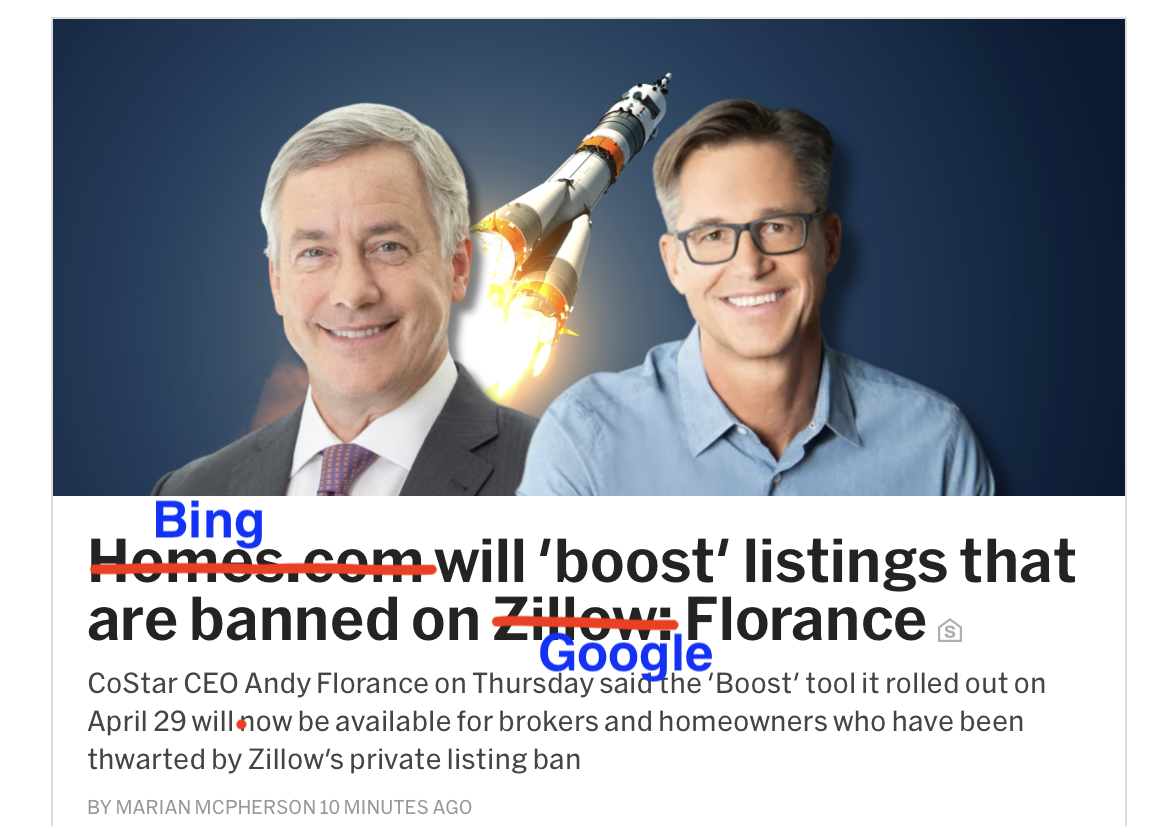
Homes.com will ‘boost’ listings that are banned on Zillow: Florance

“Homes.com is going to support any agent who gets blackballed or blacklisted on Zillow, and boost their listing,” he told Inman exclusively on Thursday, adding that access will be free to those impacted by Zillow. “We don’t think it’s right to ban people’s listings for your economic interest.”

But what about the economic interest of the seller or the buyer?

There’s a lot I think Homes.com does well, but every now and then (like now), Mr. Florance seems to be driven by a personal vendetta against Zillow. And look, I’m not always the biggest fan of Zillow either (for example, I don’t think Homes.com ever sued their own clients).

But in the end, this feels like a hollow threat.

To put a finer point on it, I updated the graphic that accompanied the Inman article today.

The ruins of Remine

Mega MLSs are attempting to sell Remine — either whole or in parts

“The MLSs collectively paid $53.5 million to buy Remine. Remine is a wholly-owned subsidiary of MLS Technology Intermediate Holdings, which is a wholly-owned subsidiary of MLSTH.

According to legal filings, on February 19, MLSTH hired Rock Creek Ventures, a financial advisory firm that specializes in business restructuring, to run an eight-week sale process for Vienna,Virginia-based Remine under a proceeding known as an assignment for the benefit of the creditors or ABC.

According to the American Bar Association, an ABC “is a business liquidation device available to an insolvent debtor as an alternative to formal bankruptcy proceedings”

Embarrassing. And it couldn’t come at a worse time.

Why is Robert Reffkin spreading lies about MLS?

Bright MLS CEO checks Robert Reffkin on Clear Cooperation Policy

“What concerns us the most is that these false claims are trying to harm us and benefit primarily the brokerage through sellers not getting the widest exposure for their listing.

“In our view, it could put homebuying and selling in the hands of a select few agents who could choose with whom they want to share information. Ultimately, we think getting rid of the norms and protocols about how information is shared would slide the real estate industry down the mountain into a heap where buyers and agents are forced to pore through online marketplaces and thousands of brokers’ sites to weed out scams and find possible properties. I am confident no one thinks that’s a good idea.”

Brian Donnellan, CEO Bright MLS

Masterful rebuttal from Brian Donnellan calling out Refkkin’s nonsense. At CMLS the misinformation Reffkin was putting out on stage reminded me of another meme.

But why put on such a show? What with all the hand waving? We all know what’s going on. Brian Boero’s post, “Clearing the air of Clear Cooperation” laid it out.

“Some big brokers, among whom Compass is the most vocal, want to accelerate their private listing efforts. Compass has been quite clear about their desire to become a listing destination. Given years of eroding margins, and the potential for commission compression in a post-settlement world, big brokers would like to keep as many transactions in-house as possible and fully leverage their hard-won market share. A critical mass of private, exclusive listings is also a big recruiting lever.

Why not just say that? It’s an obviously rational position, and one that is not inherently evil.”

It seems that culturally, we now rely on fear as the main way to make a point. Whether it’s immigrants ‘eating our cats and dogs’ or the ‘end of democracy.’ Just stop.

And by the way, if Reffkin or any other broker thinks that private/exclusive listings are the right strategy to increase their margins, they need to think harder about this problem. The market will turn, and coming up with band-aid solutions to current problems is not the answer. The real reason you’re failing is that you’re not delivering value to your customers. Focus on that, not on spreading fear.

What does the “Z” in MAZL, LLC stand for?

Update on the Pending Sale of REcolorado to MAZL, LLC

“Firstly, as noted in our public FAQ, MAZL, LLC, is a private company formed specifically to acquire the MLS service. Joseph E. Burks is the sole and only purchaser of REcolorado. He created MAZL, LLC specifically to execute the Letter of Intent (LOI) and complete the business transaction. There are no other investors.”

Denver Metro Association of REALTORS(r)

Okay, I’m just having a little fun with the title of this post. I don’t think Zillow has anything to do with the sale of REcolorado MLS. But I do want to point something out, and it may be obvious already to some but I don’t know why more people are not talking about it.

One person, in this case Joseph Burks, is about to own the 16th largest MLS organization (by agent count) in the country. I don’t think anyone really understands what the second order consequences of this decision could be. 🍿

Don’t shit where you eat

How it started…

President of Powerful Realtors Group Is Accused of Sexual Harassment

“Ms. Brevard, 51, was fired in September 2022 for failing to disclose her relationship with Mr. Parcell, according to the lawsuit she filed in federal court in Washington, D.C., in June.

She had worked at N.A.R. as what was called its “chief storyteller” and handled the group’s podcasts, videos and much of its marketing materials from 2019 to 2022. According to her complaint, she had a monthslong sexual relationship with Mr. Parcell. After she ended it, Mr. Parcell continued to press her with unwanted advances, saw to it that she was excluded from meetings and business trips and told her that he would have her fired, the lawsuit claimed”

Debra Kamin reporting for the New York Times

How’s it going…

NAR President Kenny Parcell resigns after NYT exposé

“The calls for Parcell’s resignation intensified over the weekend, as a growing number of industry leaders called on NAR to hold Parcell accountable for his actions. Anywhere Brands President and CEO Sue Yannaccone was one of the first high-ranking brokerage leaders to make a statement, with her Monday LinkedIn post garnering increasing attention throughout Monday afternoon.

“I was very disturbed to read The New York Times report on the brazen attitudes and alleged behaviors of leaders at the National Association of Realtors,” Yannaccone said. “Given our predominantly female industry, I am incredibly disappointed by the reporter’s allegations as NAR is supposed to be a guidepost for our industry.”

Marian McPherson reporting for Inman News

The Times article was a bit of a head scratcher for me. In my opinion, after thinking about it for the last couple days, and talking to people it’s amazing to me this clown didn’t resign when he was first caught in a sexual relationship with a staffer. This guys outsized ego just sullied a lot of people’s good reputation and future prospects.

Sponsored By ICE