“A CRM makes sense for Zillow. The acquisition demonstrates that the evolving proptech remains on a path to become an increasingly influential presence in the residential real estate industry with consumers and agents.
It has taken on a number of software brands of late, starting with ShowingTime in early 2021, which became the basis for ShowingTime+, an umbrella brand under which a litany of agent-oriented marketing services come to rest, such as Listing Showcase and Aryeo, a marketing media management solution which it scooped up in August.
Follow Up Boss will not be part of ShowingTime+, Zillow President Susan Daimler told Inman.”
Craig Rowe for Inman News
Congrats to Dan and his team. Follow Up Boss is all about culture. I think it’s smart not to roll them in to the ShowingTime+ team. Also, talk about timing….
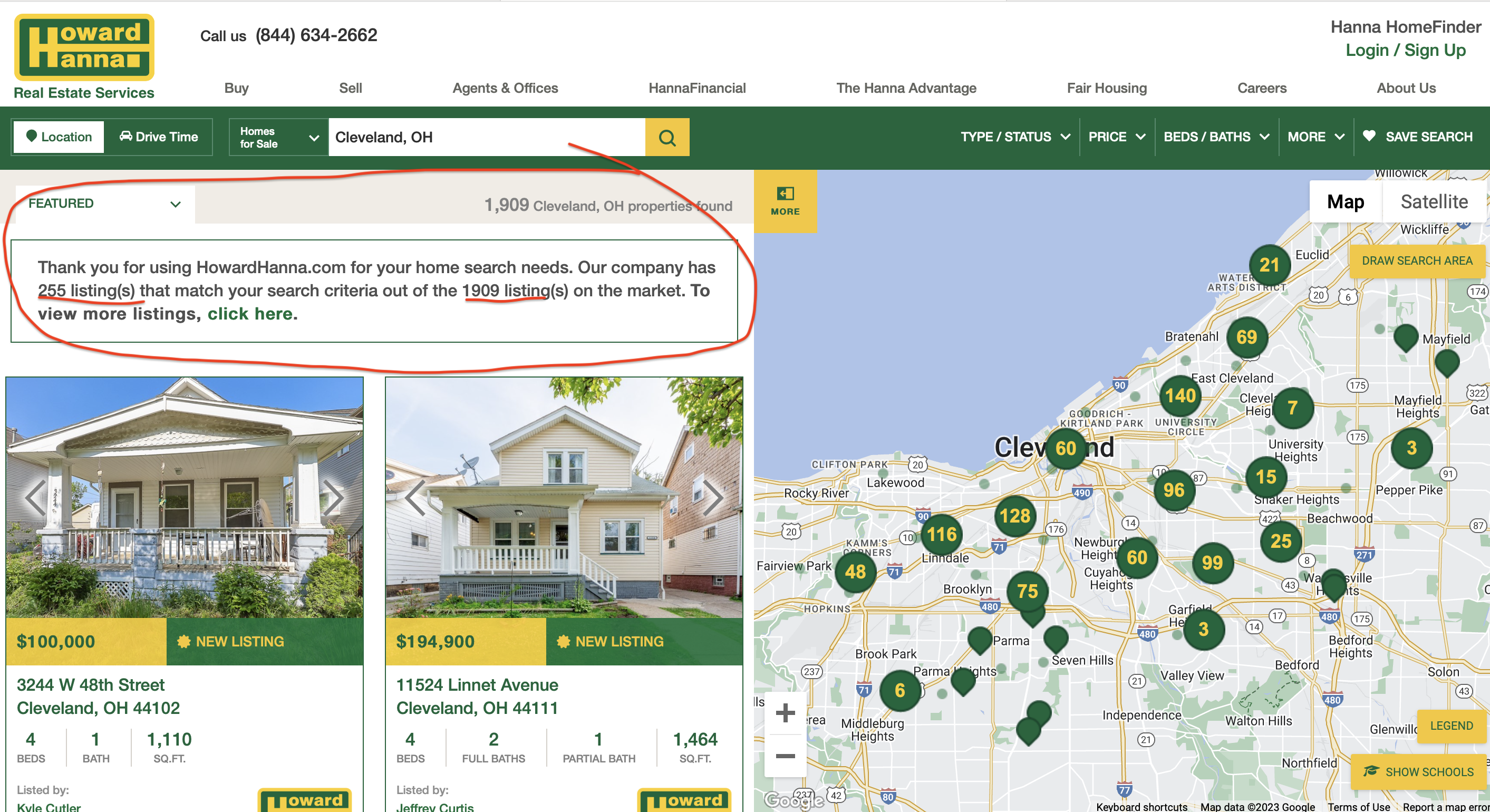
This is a head-scratcher. I’m not sure I fully understand what is going on here but I’ll try and explain. From the video, HowardHanna.com appears to be leaving IDX. Currently, they are showing only HH listings and you must register to see more.
So is Howard Hanna pulling out of IDX? Is there some sort of selective listing opt-out mechanism? Mr. Hanna also says they will “still be partnering with the national portals, and figuring what the strategy will be with them.” I can’t for the life of me figure out how since most of the national portals use an IDX feed. Can you blend an IDX feed with a direct feed from a broker?
Genius or bat-shit crazy? I don’t yet understand the strategy fully until some of these questions are answered. I guess if they are super dominant in that market then it might make sense.
But if I’m a listing agent in Ohio that is competing with Howard Hanna the first thing I would bring up at a listing presentation is something to the tune of, “Howard Hanna won’t promote your listings on all websites, I will”.
I’ll be hosting a Twitter Spaces on this subject today at 1PM PT. Join us!
“During Tuesday’s investor call, Florance compared CoStar’s portal ambitions to the choice consumers face between buying a home verses building something new. But thanks to what Florance described as Homes.com’s success with traffic, and its positive reception within the real estate industry, CoStar has apparently settled for now on the building, rather than buying, strategy.
We feel we have a unique offering on the organic side that no one else is offering out there,” Florance said at another point during the call.
Tuesday’s earnings report states that Homes.com now has more than 20 million unique monthly visitors.”
I guess we shouldn’t be surprised, remember when CoStar was going to buy CoreLogic? Good times.
Ultimately this was a head-scratcher anyway, how was CoStar going to manage two brands? Rob and I went over this on an episode of Industry Relations.
I love the optimism here from Andy, but Realtor.com traffic is roughly 5 times that of Homes.com, and Zillow is 10 times that of Homes.com. I still can’t believe Andy’s grand plan is to “beat Zillow”, especially organically. I keep believing there has to be something else…some other plan yet to be revealed. Beating Zillow seems like a fool’s errand.
“Customers who start their selling journey with Zillow can now simultaneously request both a cash offer from Opendoor and an estimate of what their home could sell for on the open market with a local Zillow Premier Agent partner.”
It reminded me of what we launched waaaaay back in 2018, called iBuyer Connect:
“Agents using Cloud CMA, a comparative market analysis tool for listing presentations from W+R Studios, can now present listing clients with an all-cash offer from iBuying giant Opendoor alongside the traditional listing information.”
This integration in Cloud CMA has helped agents sell tens of millions of dollars of real estate without charging a 35% referral fee. And a majority of those sellers still wanted to be represented by the agent.
“Rupert Murdoch’s News Corp. is in talks to sell its Move Inc. online real estate business to CoStar Group Inc.
Move is the parent of Realtor.com and other real estate-related websites. The deal is worth about $3 billion, according to people familiar with the matter, who asked not to be identified because the discussions are private. The sale could be announced within days, one of the people said.”
After CoStar announced at a recent earnings call they had raised $750M for future acquistions Rob and I on our Industry Relations podcast tried to guess what they would scoop up. I thought we had a pretty good guess with Matterport. Matterport had recently bought VHT Studios. So we thought it would give them some killer IP and a network of photographers. Turns out Zillow took the bait and purchased VRX, and CoStar had bigger fish in mind. Although $3 billion isn’t that much money for CoStar, remember they bid $7 billion for CoreLogic.
Brings up a few questions. Will NAR approve? Or do they even have the say? If NAR was cool with handing the reins to Rupert Murdoch, then Andy Florance seems like a Boy Scout.
What about Homes.com? I’ve been wondering when the new website would be launched, and they recently had a big round of layofffs. Maybe Andy realized that it would take a hell of lot more money to get Homes.com (a distant #3) to compete with Zillow than it would take #2, realtor.com. And the whole “your listing, your lead” actually might play better under the realtor.com umbrella.
“We want to help agents effortlessly deliver standout listings that wow their sellers and help win over potential buyers,” said Cynthia Taylor, vice president of product for ShowingTime+. “Listing Media Services cuts down on the time agents spend preparing a listing so they can focus on the high-touch, high-value work they do as a trusted adviser for their clients.”
… select agents will receive the keys to a new best-in-class listing display — Listing Showcase.
Until now, online listings all conformed to the same structure. Listing Showcase is a NEW style of listing display that truly differentiates top-tier agents in their market.
Aren’t these two things; better content and new ways to highlight listings, exactly what CoStar was promising with their brand-new Homes.com?
Looks like Zillow just hijacked CoStar’s business model.
“Homeownership remains the American Dream because it is one of the most powerful avenues for building wealth, and a source of long-term social and financial stability,” said Rob Chrane, CEO and founder of Down Payment Resource. “Unfortunately, many people sideline themselves from buying a home because they don’t know that there are thousands of homebuyer assistance programs that may be able to help them overcome common affordability challenges, such as down payment and closing costs. By partnering with Down Payment Resource, Zillow is doing the important work of raising awareness about these programs while providing its users with a tool that could make the difference between continuing to rent and owning a home.”
Well, this certainly brought a smile to my face! I’ve been a big fan of Rob and his company, Down Payment Resource for a long time. Just to think that there are people in a house right now, maybe warming themselves by a fireplace, who were able to buy the house with information they gained from this service fills me with the holiday spirit. 🥹
“Zillow Group (NASDAQ: Z and ZG) today announced it has closed on the acquisition of VRX Media. This real estate media marketing and services leader is known for its aerial drone photography, virtual staging, 3D tours, high-definition photography and fast-media delivery to clients, which is made possible through the company’s national professional photographer network. Zillow Group will continue to offer VRX Media’s services through the ShowingTime+ software suite.”
Smart, and obviously a move to help Zillow compete against CoStar’s yet-to-be-announced launch of the new Homes.com which is said to offer “listing enhancement” packages.
I had made a prediction on the Industry Relations podcast that CoStar might buy Matterport because Matterport had recently bought VHT Studios which also had a nationwide professional photographers network. I guess Zillow thought it was a good idea too.
Thank you, next? In another sign that MLS organizations are starting to take control of their own destinies, Katie Smithson has left Zillow and taken a senior position at CRMLS.
CRMLS Appoints Katie Smithson as new Chief Revenue Officer
CHINO HILLS, Calif., November 7, 2022 — On November 15th, California Regional MLS (CRMLS) will welcome their latest executive appointment, Katie Smithson in the role of Chief Revenue Officer (CRO). Smithson is a long-time veteran in the real estate industry with a history of MLS relation management and product innovation. Smithson has been in the real estate industry for 14 years, most recently as Director of MLS Relations for Bridge Interactive with Zillow.
In her new role, Smithson will be directing revenue operations, ensuring proper communication and collaboration between all the revenue-generating departments at CRMLS. She will be charged with improving customer satisfaction, product strategy, and sales performance.
“We’re looking forward to welcoming Katie to the CRMLS Executive Team,” says CRMLS CEO Art Carter. “Her experience is invaluable, and I am confident that she will be a great addition to the company as the MLS industry evolves and CRMLS moves forward as a company. “
“I am excited to join the extremely talented team at CRMLS,” says Smithson. “I’ve worked with them for years and always admired the caliber of leadership, so when this opportunity came along, it only made sense to say yes. I am inspired by the vision CRMLS has and can’t wait to help shape the future of our industry.”
As a vendor in the MLS Industry Smithson has an extensive track record of success in building B2B relationships, increasing returns, and developing product offerings. She has also served as a NAR REACH mentor, a board member for the Council of MLS with a CMLX 1 certification, and RESO Board Secretary.
About California Regional Multiple Listing Service (CRMLS)
California Regional MLS is the nation’s largest and most recognized subscriber- based MLS, dedicated to servicing more than 110,000 real estate professionals from 41 Associations, Boards, and MLS organizations. CRMLS is the industry powerhouse and thrives on providing the most relevant products and services to its subscribers. For more information on CRMLS, visit www.crmls.org.
“The brand, dubbed ShowingTime+, is the latest development in Zillow’s ongoing attempts to build a “housing super app.” As it’s name implies, the brand includes popular showing management platform ShowingTime, as well as other offerings such as dotloop and Bridge Interactive. When the company announced the move Monday, it framed ShowingTime+ as an effort to win over agents.
But in the days following the announcement, the response from industry professionals has been mixed at best.”
I’m not sure this “mixed at best” statement is that fair. I mean, how many agents did they really talk to? But I do have some thoughts about what I think Zillow got right and wrong with the launch.
What they got right.
I think it’s super smart to put the teams together. ShowingTime, dotLoop and Bridge Interactive have a ton of smart people so getting them to work together as one makes a ton of sense. I think this move alone was worth the effort.
What they got wrong.
First, I think there was a missed opportunity in the naming. Never mind the lazy addition of a “+” to the end of ShowingTime, which I’ve already joked about. It’s been a minute since the acquisition of ShowingTime and things seem to have settled. But leading with the name “ShowingTime” has seemed to have caused agents to bring out the pitchforks again. Don’t get me wrong, I think ShowingTime is a great company and service, but it now has…baggage. I have to think either renaming ShowingTime or at least giving the umbrella brand (bundle?) a new name with ShowingTime underneath might have been a better option.
The final thing is a head-scratcher for me. Leadership. Why isn’t Errol Samuelson leading this effort? I don’t know Jun Choo. He seemed to have impressed Zillow’s leadership and has some OG creds, all the way back to HouseValues.com. Maybe Errol didn’t want it? But all these products touch MLS in some shape or form and I’ve always thought of Errol as one of the best product guys in the industry. That’s who I would want as my quarterback.